|
Antiques,
Collectibles, Vintage Shopping
|
|
|
|
Collector
Books, Reviews, Education
|
|
|
|
Online
Museums & Directories
|
|
|
|
Discover
Collectics Variety
|
|
|
|
Cool
Stuff
|
|
|
|
|
|
|
|
|
Vintage
Sunglasses Shop - Authentic
vintage Revo, Ray-Ban, Armani,
Carrera, Alpina, Cazal, Persol, Vuarnet,
Bolle, Oliver Peoples, and French
cat's eye sunglasses!
|
|
|
|
Collectics
Antique & Vintage Sale
Coupon: Save 10% On Entire Order!
|
|
|
The Collectics
Antiques Information & Education pages are
designed to further knowledge of antiques, collectibles,
collecting styles, periods, artists, designers,
and manufacturers of fine and decorative arts.
To learn more, our Antique
Collector Bookstore lists only the best
collector books and price guides, complied by
surveys of top antique dealers and auction houses.
For a different shopping experience, you can
also browse our featured selections in a fun
new way with the Antique
Price Guides Slideshow or see current Amazon.com
bestsellers by using Collector
Books Topic Search.
|
| "prices 30% below your local antique shop or vintage store plus free shipping." Collectibles Guide 2010 |
| Peanuts
© United Feature Syndicate, Inc.
|
|
|
|
|
FLOW
BLUE CHINA AND PORCELAIN INFORMATION & HISTORY
|
|
|
Collectics
Customer Appreciation Sale
Coupon: Save 10% On Entire Order!
|
|
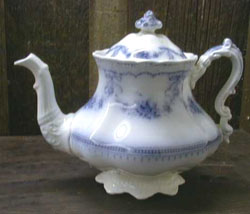
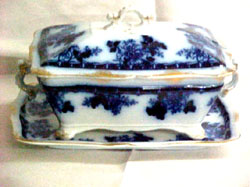
| Flow Blue china
was made from the early 1800s until just after the turn of the century.
Since the 1700s, English pottery makers had tried to copy Chinese porcelain
which exhibited many characteristics of what was to become known as Flow
Blue. Chinese porcelain was quite expensive at the time as a luxury item.
English potteries developed a type of salt-glaze earthenware which looked
somewhat like porcelain due to the unique white hue that they produced.
It could then be decorated with Chinese inspired designs and sold at much
lower cost than Chinese porcelain. Transfer printing was invented around
1775 as a new method for decorating pottery. A copper plate was engraved
with the design and warmed, at which point paint was rubbed onto the plate
and any excess removed with a small knife. Damp tissue paper was then pressed
carefully against the plate, then lifted up and pressed onto the pottery
to which the transfer was being made. The transfer was then rubbed in using
flannel after placing the pattern to be transferred in the correct position.
Then, the piece was placed in water where the tissue paper floated off,
leaving the design transferred to the piece. It was lightly heated to dry
the paint, then glazed. While some firms had their own engravers who produced
the designs, most smaller companies used engraving firms specializing in
such services.
Because the Chinese
porcelain that they were seeking to emulate had blue designs,
the English also used blue, the only color they were certain
would survive the glazing. The Staffordshire
region had well over 100 potteries producing this ware by the
early 1800s, originally pioneered by Josiah Spode. Cobalt oxide
is the base pigment used in Flow Blue, discovered in the mid
1500s. They discovered that cobalt oxide dye would sink into
the porous earthenware and blurred further during the glazing.
Around 1820, they also discovered that the flow of the blue
dye could be enhanced by using lime or ammonia chloride in the
glazing process. The degree of blur varied greatly among manufacturers,
and the flowing effect conveniently hid most manufacturing flaws
in the blanks. Josiah Wedgwood is generally recognized as the
creator of Flow Blue pottery in the 1820s. Early Flow Blue designs
were mostly oriental although other scenics were also produced.
Scenes of all types were usually romanticized visions of foreign
lands, often mixing cultures and with the sole purpose to create
desirability in the products. After 1850, styles became quite
ornate and the scenes depicted even more fanciful. While some
think that Flow Blue was discovered by accident, most experts
believe that the development of the blurring technique and its
use in production was quite intentional, a technique which produced
works still in high demand today.
Ever been fooled by
a fake or a seller that didn't deliver the goods as described?
At Collectics, we authenticate and stand behind everything we sell, at
prices "30% below your local antique shop" according
to Collectibles Guide 2010. Please browse our main Antiques
& Collectibles Mall to find a treat for yourself or
a great gift for others, all with free shipping. Thanks for visiting and shopping at Collectics!
Buy
period Flow Blue china and much more on the Collectics Porcelain
& China and Fine Antiques pages, or search the entire site for great antiques,
collectibles, and crafts for every collector!
|
|
|
Cool
Coupons & Promo Coupon Codes for Disney, Brookstone,
Avon, Netflix, eBags, and more @ our Coupon
Site!
|
|
|
|
|
|
Amazon.com:
Earth's Biggest Store!
|
|
|
|
Collector Book Purchases & Advertising Support Our
Free Online Museums, Antiques & Collectibles Information,
and Directories - Thank You! |
|
|
|
|
|
|
|
Display
Cases for collectibles, figurines, diecast
cars, sports memorabilia, dolls, and more!
|
|
|
|
Copyright
© Collectics. All rights reserved.
|
|