|
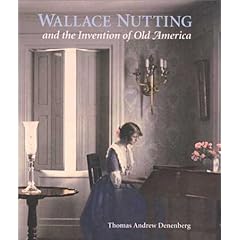
By the 1920s, Wallace
Nutting was both a household name and a trademarked brand. He
understood America's early consumer culture and the combined
power of photography, writing, and personal promotion. He sold
photographs, hand-tinted platinum prints of early colonial life,
and exact reproductions of colonial furniture and ironwork through
catalogs, traveling salesmen, and department stores. He promoted
them by writing books, giving speeches, and hiring a Madison
Avenue advertising agency. Although not born into wealth, Nutting
(1861-1941) was descended from early Plymouth Colony settlers.
His father died in the Civil War, so he grew up with his mother
and his uncles in Maine. He attended Phillips Exeter Academy,
Harvard College, and both the Hartford and Union Theological
Seminaries. He served as a Congregational minister in Seattle,
Minneapolis, Newark, and Providence for several years. In 1904,
he had a nervous breakdown and left the ministry. His doctors
prescribed photography as therapy, and that began Nutting's
great commercial future. He toured New England, photographing
pastoral landscapes and domestic "colonial interiors",
and he carefully began copyrighting over 800 photos with the
Library of Congress.
In 1905, he moved to
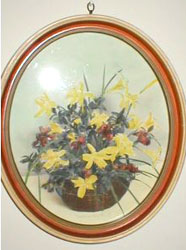
Southbury, CT and hired a staff of women to hand-color his prints
of idyllic landscapes and colonial style rooms. His interiors
show young women dressed in colonial style outfits, often sewn
by his wife Mariet, and doing domestic chores. Nutting sold
more than 5,000,000 of these hand-tinted prints and making over
$1000 per day. By 1915, he had a catalog of 1000 images for
sale out of a total of 50,000 negatives. In 1912, he moved to
a larger house in Framingham, MA and began buying historic structures
to use as settings for his photographs, restoring them and decorating
them with period furnishings. Eventually he opened them to tourists
and called them the Wallace Nutting Chain of Colonial Picture
Houses. He began collecting American antiques for the homes
and bought pieces from the 17th century including a carved 1685
Sunflower chest in oak, pine, and maple which he found in Wethersfield,
CT. He also bought 18th century pieces and amassed a huge collection
of chests of drawers, Windsor chairs, cupboards, boxes, bookcases,
cabinets, and more.
In addition, he purchased
over 600 period domestic utensils made of wood, pewter, and
wrought iron. In 1928, Nutting wrote the book "Furniture
Treasury" illustrated with pictures of his own collection
as well as other's, the first widely circulated reference book
on American antiques. In 1917, Wallace Nutting opened a furniture
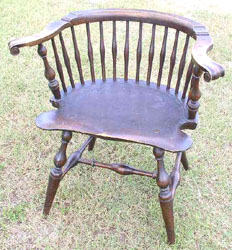
factory in Saugus, MA to make reproductions of his antiques
collection. He started with Windsor chairs and sold them by
the thousands, expensive even in their day. In 1925, he sold
his collection of American antiques for $200,000 to J. P. Morgan
Jr., who donated it to his hometown museum Wadsworth Atheneum
in Hartford, CT. Nutting's business faltered during the Depression,
and by 1932 the market for reproductions had plummeted. He donated
his furniture, tools, and plans to Berea College in Kentucky
upon his wife's death in 1945.
Ever been fooled by a
fake or a seller that didn't deliver the goods as described?
At Collectics, we authenticate and stand behind everything we
sell, at prices "30% below your local antique shop"
according to Collectibles Guide 2010. Please browse our main
Antiques & Collectibles
Mall to find a treat for yourself or a great gift for others,
all with free shipping. Thanks for visiting and shopping at
Collectics!
Buy
period American antiques on the Collectics Fine Antiques pages, or search the entire site for great antiques,
collectibles, and crafts for every collector!
|