|
Antiques,
Collectibles, Vintage Shopping
|
|
|
|
Collector
Books, Reviews, Education
|
|
|
|
Online
Museums & Directories
|
|
|
|
Discover
Collectics Variety
|
|
|
|
Cool
Stuff
|
|
|
|
|
|
|
|
|
Vintage
Sunglasses Shop - Authentic
vintage Revo, Ray-Ban, Armani,
Carrera, Alpina, Cazal, Persol, Vuarnet,
Bolle, Oliver Peoples, and French
cat's eye sunglasses!
|
|
|
|
Collectics
Antique & Vintage Sale
Coupon: Save 10% On Entire Order!
|
|
|
The Collectics
Antiques Information & Education pages are
designed to further knowledge of antiques, collectibles,
collecting styles, periods, artists, designers,
and manufacturers of fine and decorative arts.
To learn more, our Antique
Collector Bookstore lists only the best
collector books and price guides, complied by
surveys of top antique dealers and auction houses.
For a different shopping experience, you can
also browse our featured selections in a fun
new way with the Antique
Price Guides Slideshow or see current Amazon.com
bestsellers by using Collector
Books Topic Search.
|
| "prices 30% below your local antique shop or vintage store plus free shipping." Collectibles Guide 2010 |
| Peanuts
© United Feature Syndicate, Inc.
|
|
|
|
|
ANTIQUE
MERCURY GLASS INFORMATION & HISTORY
|
|
|
Collectics
Customer Appreciation Sale
Coupon: Save 10% On Entire Order!
|
|
|
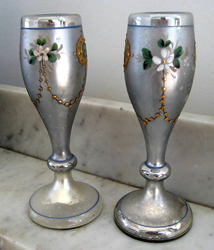
Mercury glass was produced
in the United States, Bohemia (now the Czech Republic), Germany,
and England from around 1840 until the early 1930s although
its popularity significantly eroded at the turn of the century.
Mercury glass is sometimes referred to as silvered glass, glass
that was blown double walled and subsequently silvered between
the layers with a sterling silvering liquid solution and sealed.
Although elemental mercury was used to make mirrors in the early
years of production, it was never used in tableware and after
about 1860 was almost completely replaced by the use of silver
nitrate. Mercury glass will have some type of hole or opening
in the bottom base of a piece to allow the internal silver coating
to be poured in, and then it was sealed with a glass or metal
disk to prevent tarnishing of the silver within. Silvered mercury
glass was often intricately painted, enanameled, etched, and
engraved to create intricate, luxurious looks, but it was much
more affordable than true silver and as such was referred to
as "poor man's silver". Nevertheless, researchers
have cited mercury glass vases, goblets, and diverse range of
tableware to be one of the earliest examples of true art glass,
i.e. glass produced solely for the aesthetic value and not for
some everyday purpose. Designs could be quite large and elaborate,
so they were often seen in public institutions such as alter
candlesticks in churches. Mercury glass was first patented in
England in 1849, and the first U.S. patent was registered in
1855. Some U.S. mercury glass was made and marked by the New
England Glass Company, while English mercury glass is sometimes
marked E. Varnish & Co or F. Hale Thomson.
Ever been fooled by
a fake or a seller that didn't deliver the goods as described?
At Collectics, we authenticate and stand behind everything we sell, at
prices "30% below your local antique shop" according
to Collectibles Guide 2010. Please browse our main Antiques
& Collectibles Mall to find a treat for yourself or
a great gift for others, all with free shipping. Thanks for visiting and shopping at Collectics!
Buy
period Tramp Art, needlepoint, and other handmade artworks on the Collectics
Art
& Prints, Memorabilia,
and Clothing &
Textiles pages, or search the entire site for great antiques,
collectibles, and crafts for every collector!
|
|
|
Cool
Coupons & Promo Coupon Codes for Disney, Brookstone,
Avon, Netflix, eBags, and more @ our Coupon
Site!
|
|
|
|
|
|
Amazon.com:
Earth's Biggest Store!
|
|
|
|
Collector Book Purchases & Advertising Support Our
Free Online Museums, Antiques & Collectibles Information,
and Directories - Thank You! |
|
|
|
|
|
|
|
Display
Cases for collectibles, figurines, diecast
cars, sports memorabilia, dolls, and more!
|
|
|
|
Copyright
© Collectics. All rights reserved.
|
|