| Much of the
collector interest in European ceramics from the early 20th century has
been focused on western European countries, but a major art pottery movement
reflecting the design elements of the Art Nouveau (Jugensdtil) and Secession
periods during which it arose was burgeoning in what was then known as
Bohemia. Traditionally, Amphora referred to large Greek storage vessels
with an oval body, usually tapering toward the base, and with two handles
extending from just below the lip to the shoulder. However, the area of
central Europe now part of Austria and Czechoslovakia produced a very fine
art pottery also known as Amphora from the late 19th century until the
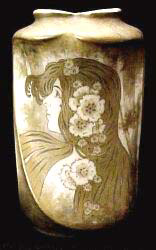
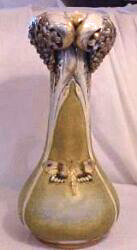
early 20th century. Amphora employed very innovative shapes including figurals
especially during the Art Nouveau period when their female busts were sometimes
monumental and reflected a level of detail very seldom seen in porcelain
manufacturing. Amphora works also incorporated animals into their designs
including serpents, parrots, and dragons, and other styles were unique
to the Amphora manufacturers such as the "drop edge candle vase". Amphora
designs began with a drawing or watercolor which captured the desired finish
look of the piece, and once the design committee had given approval to
the design it was given a style number which was subsequently impressed
or inscribed on the bottom of Amphora works. Many Amphora designs were
produced in a variety of sizes, with the larger and more substantial being
more complex to make and commanding higher prices originally. As such,
the larger size pieces such as female busts are less common since they
were less affordable during their original production, so they are consequently
rarer and more desirable for collectors. You can see some of the finest
Teplitz Amphora including the Art Nouveau porcelain busts on the pages
of the Collectics Online Museum 1890-1935.
Generally recognized
as the first and arguably the best of the Amphora manufacturers,
Reissner, Stellmacher & Kessel was established in the Turn-Teplitz
region of Bohemia in 1892. Partners Hans and Carl Reissner,
Edward Stellmacher, and Rudolf Kessel after Kessel took over
the remaining factories of Alfred Stellmacher. This area of
central Europe was close to Dresden, Germany and benefited from
the long tradition of ceramics manufacturing among the peoples
of eastern Germany. The ceramics Reissner and his 2 partners
produced was known for its unique styles and the interesting
glazes they used to create what became known as "Amphora" pottery
or simply "Teplitz." Reissner, Stellmacher & Kessel (R.
St. K.) displayed their work in America for the first time at
the 1893 Chicago World's Fair where they were awarded a best
in show prize and first attracted the attention of the American
buying public. In 1897, R. St. K. produced began art pottery
vases in the style of Grueby
and Rookwood,
but with more elaborate and Art Nouveau and Jugensdtil influenced
designs. The partners Reissner, Stellmacher, and Kessel enjoyed
business and artistic success and again took top honors at the
St. Louis World's Fair in 1904, but in 1905 at which time Stellmacher
left the firm to establish his own company under his own name.
The original firm continued to operate as the Reissner &
Kessel Amphora Works and operated as such until Kessel also
left in 1910. Subsequently, the original firm operated under
the business name Amphora Werke Reissner while Stellmacher continued
in operation only until 1912. Amphora Werke Reissner continued
to produce fine Amphora art pottery through the Art Deco period
and the years of World War II, at which time it was nationalized
by the Czechoslovakian government in 1945. There were many other
Amphora manufacturers who established operations in the Turn-Teplitz
region, while imitators emerged elsewhere such as the Zsolnay
factory in Pecs, Hungary which went on to create some innovative
designs of their own.
In addition to Reissner,
Stellmacher, and Kessel marked works, one also sees very high
quality works which were produced at the Imperial Technical
School for Ceramics & Associated Applied Arts from which
many of the Amphora designers and artisans graduated. Created
in 1885 and continuing in operation through World War I until
1917, the school was a decorative arts and design academy which
taught students how to sculpt clay in a manner that was both
complex in technique and reflective of "themes" such as nature
which was so influencing the Art Nouveau period. The manufacturers
of the region benefited from the supply of talent produced at
the school, and they contributed to its operation by providing
lecturers and raw materials including clay with which the students
worked. In the Waltraud Neuwirth book Art Nouveau in Blossom:
Austria, a 1908 report describes the curriculum at
the school as including "a plant in a given space, to be put
into a stylized representation, with consideration for an effective
special distribution. Model an animal in a stylized shape. Design
a simple vessel with handle and plastic decoration represented
in relief. Line up plant motifs to form a frieze and represent
them plastically. Design and model a flower pot employing flow
glazes. Sketch a figure (nude) after a live model."
Ernst Wahliss of Turn-Wein,
Austria was another early Amphora art pottery designer who enjoyed
success beyond the confines of Europe, and Wahliss produced
between 1897 and 1906 some of the most beautiful female Art
Nouveau busts which are highly sought by collectors today given
their beauty and technical complexity. Wahliss was somewhat
unique among the Amphora manufacturers for having established
his own retail shops in London and Vienna. Another well known,
high quality Amphora manufacturer was the firm of Julius Dressler
whose manufacturing operation was founded in Belia, Bohemia
in 1883 and operated until 1944. During the early 20th century,
Bohemia was part of the fading Austrian-Hungarian empire. Amphora
was sold in the United States by finer decorating shops including
Louis
Comfort Tiffany of New York, who appreciated the innovative,
hand crafted designs, vibrant colors, and unique glazes used
by the Amphora manufacturers from Turn-Teplitz, Bohemia- now
the town of Trovany in Czechoslovakia. Amphora works from this
period were extraordinarily complex in manufacturing technique,
often requiring as many as 10 firings, a series of decorators,
and finishers to did the final style flourishes like gilding.
Almost all European Amphora art pottery produced during this
period was marked with various Amphora and factory marks including
style numbers and in many cases artist's signatures such as
Paul Dachsel whose "PD" marks decorated some of the work emanating
from Reissner, Stellmacher, & Kessel from 1892 to 1905.
Dachsel himself left Reissner in 1905 at the same time as Edward
Stellmacher to form his own firm "PD Turn-Teplitz."
Ever been fooled by
a fake or a seller that didn't deliver the goods as described?
At Collectics, we authenticate and stand behind everything we sell, at
prices "30% below your local antique shop" according
to Collectibles Guide 2010. Please browse our main Antiques
& Collectibles Mall to find a treat for yourself or
a great gift for others, all with free shipping. Thanks for visiting and shopping at Collectics!
Buy
period Reissner, Stellmacher, Kessel, Wahliss, and Imperial
Amphora plus other finer art pottery on the Collectics Pottery
and Fine Antiques pages, or search the entire site for great antiques,
collectibles, and crafts for every collector!
|