|
| Carnival
glass originated in America although other countries also began
to produce similar types of relatively low cost iridescent glass.
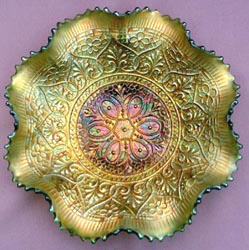
Carnival glass is made in an amazing variety of patterns, both
geometric and naturalistic, formed in a mold and then hand finished
and decorated. The iridescence was created by adding metalic oxides
into the hot glass while being formed and spraying the metallic
salt solution to the still hot surface, subsequently re-firing
it in the kiln. It was the eventual melting of the salts that
created the rainbow colors of iridescence. This contrasts with
Depression
or "pressed" glass which is simpler and less expensive to make
by using molds but without the hand finishing and iridescence
of Carnival glass. It's the combination of hand decorating along
with often vibrant iridescence that really reflects the light
in the color hues of a rainbow that make Carnival glass so popular
with collectors today. Carnival glass first began to appear on
the market in its now common look in about 1904, an attempt by
early manufacturers to reproduce the general look of Louis
Comfot Tiffany "Favrile" iridescent glass for the masses.
Indeed, Carnival glass is sometimes referred to as the "poor man's
Tiffany."
Hand operated presses
that were used to form the molds had been used since 1883, lowering
the production cost of glassware dramatically when compared
to traditional hand blown glass. Molten glass was poured into
an outer mold, and then an inner mold was pressed in using substantial
pressure. When glass seeped through the mold lines or the finished
product showed the efects of the mold, these seams would be
polished out, and the myriad patterns used like the grape and
cable also served to hide the traces of the pressing. The hot
glass could also be hand finished into new shapes, elongated,
and made more interesting by forming irregular edges, flutes,
pinched and crimped edges, pleats, ruffles, scallops and countless
other effects. Carnival glass was made in most all the colors
of the rainbow, with marigold being the most common followed
by amethyst, blue, green, and red. Other colors were also made
in small quantities such as black and pastels, and colors were
also coated with white to create opalescence by changing the
hues and creating a striated effect. It should be noted that
the base color of Carnival glass is not typically the same color
as the iridescence, so you need to look at it in the light to
see the iridized colors which come through.
All types of dinnerware
and tableware were made in vast quantities by manufacturers
such as Fenton,
Northwood,
Imperial,
Dugan, and Millersburg, in shapes which included bowls, dishes,
glasses, jugs, punch bowls, and hair accessories and hatpins.
Carnival glass lost popularity during the Art Deco design period
and the tough economic climate of the depression years of the
1930s. The generic term for this iridescent pressed glass became
known as "Carnival" glass, as it was given away as prizes at
fairs and carnivals after having fallen out of favor. It is
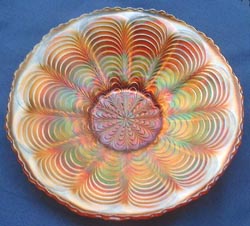
said that over 1000 patterns of Carnival glass were produced
by American manufacturers alone, with names such as beaded cable,
pineapple & bow, peacock tails, open rose, and an amazing
variety of flowers, fruits, and leaves. In the 1950s, Carnival
glass popularity rebounded, and it began being reproduced by
American manufacturers such as Imperial well into the 1960s
and 1970s, and while not as valuable as period Carnival glass
mid 20th century Carnival glass reproductions are also well
collected in their own right.
Ever been fooled by
a fake or a seller that didn't deliver the goods as described?
At Collectics, we authenticate and stand behind everything we sell, at
prices "30% below your local antique shop" according
to Collectibles Guide 2010. Please browse our main Antiques
& Collectibles Mall to find a treat for yourself or
a great gift for others, all with free shipping. Thanks for visiting and shopping at Collectics!
Buy
period Carnival, Fenton, Northwood, and other depression glass
on the Collectics Glass
& Crystal pages, or search the entire site for great
antiques, collectibles, and crafts for every collector!
|