|
Antiques,
Collectibles, Vintage Shopping
|
|
|
|
Collector
Books, Reviews, Education
|
|
|
|
Online
Museums & Directories
|
|
|
|
Discover
Collectics Variety
|
|
|
|
Cool
Stuff
|
|
|
|
|
|
|
|
|
Vintage
Sunglasses Shop - Authentic
vintage Revo, Ray-Ban, Armani,
Carrera, Alpina, Cazal, Persol, Vuarnet,
Bolle, Oliver Peoples, and French
cat's eye sunglasses!
|
|
|
|
Collectics
Antique & Vintage Sale
Coupon: Save 10% On Entire Order!
|
|
|
The Collectics
Antiques Information & Education pages are
designed to further knowledge of antiques, collectibles,
collecting styles, periods, artists, designers,
and manufacturers of fine and decorative arts.
To learn more, our Antique
Collector Bookstore lists only the best
collector books and price guides, complied by
surveys of top antique dealers and auction houses.
For a different shopping experience, you can
also browse our featured selections in a fun
new way with the Antique
Price Guides Slideshow or see current Amazon.com
bestsellers by using Collector
Books Topic Search.
|
| "prices 30% below your local antique shop or vintage store plus free shipping." Collectibles Guide 2010 |
| Peanuts
© United Feature Syndicate, Inc.
|
|
|
|
|
FENTON
GLASS INFORMATION & HISTORY
|
|
|
Collectics
Customer Appreciation Sale
Coupon: Save 10% On Entire Order!
|
|
Fenton
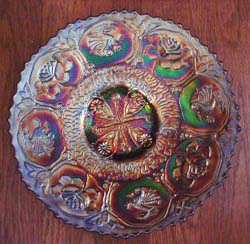
Glass Works was established in 1905 by brothers Frank and John
Fenton, first in Martins Ferry, Ohio and subsequently moving to
Williamstown, West Virginia the following year. The first real
production year was 1907, the same year that they introduced carnival
glass, and it became quite popular with a public fascinated
by the iridescent glass produced by Tiffany
and others but formerly inaccessible due to price. Carnival glass
is made by spraying glass with various types of metallic salt
solutions immediately after being removed from the glass mould.
This spray is applied while the piece is still very hot, and it
is this contact of a salts solution on hot glass that produces
a thin coating which gives the piece its lustre or iridescence.
The glass is then placed in a cooling lehr where it is slowly
cooled to relieve internal stress to prevent breakage. Fenton
made over 125 patterns of carnival glass. Most Fenton glass is
pressed by hand and hand finished, giving it higher quality and
more precision than other producers of similar works. Glass would
be poured into a mold and then removed, but it was finished with
hand tools to give it the crisp detail for which it is known.
This technique also allowed for custom features like elongated
vases, crimped edges, rolls, and so on. Most of the molds were
designed by Frank, and the production was quite varied to include
glasses, vases, goblets, and many other household items. Fenton
glass was sold by the large retail stores of the period such as
Woolworths. Other companies such as Northwood
also produced their own interpretation of carnival glass, but
Fenton arguably remained the top quality producer to meet the
huge public demand in the early 1900s. Fenton was also well known
for their opalescent
glass, a complex glassmaking technique first pioneered by
Tiffany and John LaFarge in America but perhaps taken to the pinnacle
of design by René
Lalique.
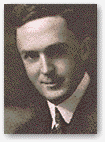
Frank L. Fenton c. 1913 |
World War I slowed down Fenton production
considerably, but they survived and largely prospered until the coming
of the Depression. During the period beginning about 1925, Fenton used
the advanced techniques of threading and mosaic work in some of their production,
but this proved too expensive and was stopped about 1927. During the depression,
the public no longer had the ability to treat themselves to luxury items
like hand made glass, so Fenton's fortunes declined. They survived by producing
highly functional colored glass tableware and other household items like
perfume bottles, performing subcontracting work for other retailers in
what today is generically referred to as Depression
Glass. Ironically, World War II was good for Fenton because no more
European glass was imported and there was still a demand for high quality,
hand made glass in the U.S. In the 1940s, Fenton's style changed markedly
to an opaque colored glass in the Victorian style, a change which proved
very popular with the tastes of the time. In the 1950s, production continued
to diversify with a focus on milk glass and particularly hobnail milk glass.
In the 1960s, Fenton produced a collector series of 12 plates commemorating
early glass makers of America. By limiting production, these plates are
relatively scarce and highly sought by collectors. The series was so successful
that they followed with other series including 12 Christmas in America
plates, Bi-centennial commemoratives, and others, and even carnival glass
was still produced into this period.
Early Fenton production
used various forms of paper labels to mark the glass. Production
after 1969 has an oval mark with Fenton inside it, differentiating
this later production from original period pieces. Other marks
developed in subsequent years, and some pieces are hand decorated
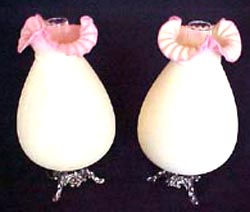
and signed by the artist. Burmese glass was introduced in the
early 1970s, opaque with a cream trending to light pink coloration.
Ever been fooled by
a fake or a seller that didn't deliver the goods as described?
At Collectics, we authenticate and stand behind everything we sell, at
prices "30% below your local antique shop" according
to Collectibles Guide 2010. Please browse our main Antiques
& Collectibles Mall to find a treat for yourself or
a great gift for others, all with free shipping. Thanks for visiting and shopping at Collectics!
Buy
period Fenton, Northwood, Carnival, and other depression glass on the Collectics
Glass
& Crystal pages, or search the entire site for great antiques,
collectibles, and crafts for every collector!
|
|
|
Cool
Coupons & Promo Coupon Codes for Disney, Brookstone,
Avon, Netflix, eBags, and more @ our Coupon
Site!
|
|
|
|
|
|
Amazon.com:
Earth's Biggest Store!
|
|
|
|
Collector Book Purchases & Advertising Support Our
Free Online Museums, Antiques & Collectibles Information,
and Directories - Thank You! |
|
|
|
|
|
|
|
Display
Cases for collectibles, figurines, diecast
cars, sports memorabilia, dolls, and more!
|
|
|
|
Copyright
© Collectics. All rights reserved.
|
|