|
Antiques,
Collectibles, Vintage Shopping
|
|
|
|
Collector
Books, Reviews, Education
|
|
|
|
Online
Museums & Directories
|
|
|
|
Discover
Collectics Variety
|
|
|
|
Cool
Stuff
|
|
|
|
|
|
|
|
|
Vintage
Sunglasses Shop - Authentic
vintage Revo, Ray-Ban, Armani,
Carrera, Alpina, Cazal, Persol, Vuarnet,
Bolle, Oliver Peoples, and French
cat's eye sunglasses!
|
|
|
|
Collectics
Antique & Vintage Sale
Coupon: Save 10% On Entire Order!
|
|
|
The Collectics
Antiques Information & Education pages are
designed to further knowledge of antiques, collectibles,
collecting styles, periods, artists, designers,
and manufacturers of fine and decorative arts.
To learn more, our Antique
Collector Bookstore lists only the best
collector books and price guides, complied by
surveys of top antique dealers and auction houses.
For a different shopping experience, you can
also browse our featured selections in a fun
new way with the Antique
Price Guides Slideshow or see current Amazon.com
bestsellers by using Collector
Books Topic Search.
|
| "prices 30% below your local antique shop or vintage store plus free shipping." Collectibles Guide 2010 |
| Peanuts
© United Feature Syndicate, Inc.
|
|
|
|
|
RENE
LALIQUE GLASS INFORMATION, HISTORY, BIOGRAPHY
|
|
|
Collectics
Customer Appreciation Sale
Coupon: Save 10% On Entire Order!
|
|
| Rene
Lalique became synonymous with French Art Nouveau decorative arts.
Rene Lalique was born in 1860 and first began designing fine jewelry
in Paris in 1881. Lalique pursued increasingly more innovative
experimentation in glass commencing around 1883. Early works used
the familiar "lost wax" technique by which the model is made in
wax while a mold is formed around the model. Then, the wax is
melted and molten glass is poured into the mold. Lalique glass
was made in this manner until approximately 1905 at which time
the factory was redesigned for a larger production. As such, the
individual uniqueness of each example of Lalique glass came to
an end with the end of the one-time only molding technique around
wax models. The success of this venture resulted in the opening
of his own glassworks at Combs-la-Ville in 1909. During the Art Nouveau period, Lalique was well known for a wide variety of objects
including perfume bottles, vases, inkwells, decorative boxes,
and bookends. In 1921 a larger factory was established at
Wingen-sur-Moder in Alsace-Lorraine. By the '30s, Rene Lalique
was world renowned as the most important designer of his time.
Lalique glass is lead
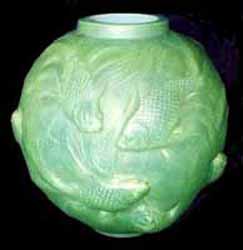
based, either mold blown or pressed. Favored motifs during the
Art Nouveau period were dancing nymphs, fish, dragonflies, and
foliage. Characteristically the glass is crystal in combination
with acid-etched relief. Later some items were made in as many
as ten colors (red, amber, and green among them) and were occasionally
accented with enameling. These colored pieces, especially those
in, black, are highly prized by advanced collectors. During
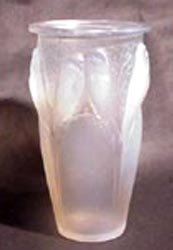
the '20s and '30s, Lalique designed several vases and bowls
reminiscent of American Indian art. He also developed a line
in the Art
Deco style decorated with stylized birds, florals, and geometries.
In addition to vases, clocks, automobile mascots, stemware,
and bottles, many other useful objects were produced. While
not well known, Lalique also experimented with bronze and other
materials as well. Most glass was clear or opalescent glass
and signed via engraving or in the mold "R. Lalique". The R.
Lalique signature was only used until 1945 with the death of
Rene. At that time, Rene Lalique's son Marc took over the company.
Production of many pieces produced prior to 1945 ceased following
Rene's death although some are still in production albeit with
a different marking. The firm is still in operation today.
Ever been fooled by
a fake or a seller that didn't deliver the goods as described?
At Collectics, we authenticate and stand behind everything we sell, at
prices "30% below your local antique shop" according
to Collectibles Guide 2010. Please browse our main Antiques
& Collectibles Mall to find a treat for yourself or
a great gift for others, all with free shipping. Thanks for visiting and shopping at Collectics!
Buy
period R. Lalique, Loetz, Tiffany, and other art glass on the Collectics
Fine Antiques and Glass pages,
or
search the entire site for great antiques, collectibles, and
crafts for every collector!
Sell
or consign finer porcelain, china, bronze, and lamps at Collectics,
where we earn our customers' trust everyday! Read
about our top performing national consignment
program for estate and personal collections.
|
|
|
Cool
Coupons & Promo Coupon Codes for Disney, Brookstone,
Avon, Netflix, eBags, and more @ our Coupon
Site!
|
|
|
|
|
|
Amazon.com:
Earth's Biggest Store!
|
|
|
|
Collector Book Purchases & Advertising Support Our
Free Online Museums, Antiques & Collectibles Information,
and Directories - Thank You! |
|
|
|
|
|
|
|
Display
Cases for collectibles, figurines, diecast
cars, sports memorabilia, dolls, and more!
|
|
|
|
Copyright
© Collectics. All rights reserved.
|
|