| Art
Deco's eclectic stylistic influences evolved from around 1900,
culminating in the beginning of the Art Deco period about 1920.
To trace the development or emergence of Art Deco, one must start
at the 1925 Paris World's Fair. The Exposition Internationale
des Arts Decoratifs et Industriels Modernes was the origin of
this controversial, new style, , heralding the coming of the modern,
industrialized world.
"Period" Art Deco is generally considered to be objects produced
from around 1925 until about 1939 when World War II engulfed Europe
and subsequently the U.S. The stylistic influences of Art Deco
continued on after the war, evidenced in many ways in 1950s design
and what we now call mid-century modern. Art Deco had a substantial
impact in most all fields of design including jewelry, sculpture,
furniture, glass, architecture, and graphic design. Artists from
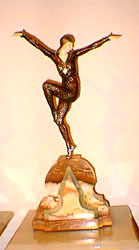
this period such as Demetre
Chiparus were influenced by Egyptian, Greek, Roman, and far
eastern themes and historical objects. Art Deco also coupled these
classical influences with modernism, evidenced in the design of
automobiles and trains, and these industrial expressions of Art
Deco made their way into consumer goods as well.
The period from 1920
until the early 1930s was marked with many contrasts, from the
wild times of the "Roaring 20s" through the Great Depression
and its aftermath. Art Deco style offered people elegant environments
of a cool sophistication, creating objects from new, man made
materials like the plastic bakelite and using exotic woods and
inlays in furniture. New and faster trains and ocean liners
were making distant lands accessible, and Hollywood and the
explosion of radio brought these adventures and of course entertainment
to the general public. Simple, geometric lines are inherent
in Art Deco design; objects were simpler than Art Nouveau but
were streamlined and elegant in their angular forms and vibrant
colors. Today, our period buildings like the Chrysler Building
in New York City with its ornamental gargoyles and silver spire
reminiscent of giant sunbeams-- a popular Art Deco theme--preserve
Art Deco design. The Empire State Building was constructed immediately
after the depression, and the project was one of the only large
scale construction projects still ongoing in those difficult
times. The pink and blue neon hotels of Miami Beach still remind
us today of the elegant yet simple design characteristics of
Art Deco. Industrial design thrived during the Art Deco period,
and a fascinating variety of consumer goods were produced at
all price ranges incorporating the streamlined Art Deco style.
Even transportation mediums like trains and automobiles became
aerodynamic. In fact, many of the most famous designs of the
20th century were designed in the Deco style - Rockefeller Center,
the Golden Gate Bridge, movie theaters, gas stations, bus stations,
diners, the S.S. Normandie, Greyhound buses, Air-King radios,
and the Electrolux vacuum cleaner. Designers of Art Deco furniture
embellished and sometimes entirely covered their pieces in exotic
materials such as mother-of-pearl, sharkskin, snakeskin, gold
and silver leaf, crushed egg shell lacquer and ivory. These
materials usually formed some type of pattern such as flowers
or a geometric motif. Well known Art Deco designers include
Donald Deskey, Russel Wright, Norman Bel Geddes, Paul T. Frankel,
and Emile-Jacques Ruhlman.
Man-made materials were
incorporated into industrial design like plastics (bakelite,
lucite), chrome, and aluminum. The use of plastic also made
possible the production of consumer goods like radios inexpensively,
in mass quantities, and in shapes and colors previously unattainable.
Bakelite
radios from this period like Spartan and Fada
are highly collected, but at their time of production they were
bringing colorful design and the sound of radio to the public
through industrialization and mass production techniques. Manufacturers
such as Chase and Farberware introduced streamlined shapes into
even the world of cocktail shakers, best evidenced by the well
known zeppelin design plus other interpretations of skyscrapers,
etc. Art Deco interior design and furnishings also used materials
like chrome and other metals, glass, and plastics in new and
innovative ways and styles. Art Deco furnishings lend a sense
of elegance and style in interior decorating, and the design
constant of streamlining enables diverse furnishings to coexist
seamlessly in a room to create a modern appearance. The graphic
arts were also heavily influenced by Art Deco, and streamlining
made its way into advertising in travel posters for ship or
train travel and even the Coca-Cola bottle designed by Raymond
Loewy. You can clearly see the influences of cubism pioneered
by Picasso and Braque in Art Deco graphic arts, as reality is
distorted by condensing the design to simple lines and angular
shapes.
Ever been fooled by
a fake or a seller that didn't deliver the goods as described?
At Collectics, we authenticate and stand behind everything we sell, at
prices "30% below your local antique shop" according
to Collectibles Guide 2010. Please browse our main Antiques
& Collectibles Mall to find a treat for yourself or
a great gift for others, all with free shipping. Thanks for visiting and shopping at Collectics!
Buy
period Art Deco decorative arts on the Art
Deco & Art Nouveau and Fine Antiques pages. If you prefer, please use our convenient Search
Engine!
Sell
or consign period Art Deco bronze, glass, porcelain, and lamps at Collectics,
where we earn our customers' trust everyday!
Read about our top performing national consignment program for estate and personal collections. |