|
Antiques,
Collectibles, Vintage Shopping
|
|
|
|
Collector
Books, Reviews, Education
|
|
|
|
Online
Museums & Directories
|
|
|
|
Discover
Collectics Variety
|
|
|
|
Cool
Stuff
|
|
|
|
|
|
|
|
|
Vintage
Sunglasses Shop - Authentic
vintage Revo, Ray-Ban, Armani,
Carrera, Alpina, Cazal, Persol, Vuarnet,
Bolle, Oliver Peoples, and French
cat's eye sunglasses!
|
|
|
|
Collectics
Antique & Vintage Sale
Coupon: Save 10% On Entire Order!
|
|
|
The Collectics
Antiques Information & Education pages are
designed to further knowledge of antiques, collectibles,
collecting styles, periods, artists, designers,
and manufacturers of fine and decorative arts.
To learn more, our Antique
Collector Bookstore lists only the best
collector books and price guides, complied by
surveys of top antique dealers and auction houses.
For a different shopping experience, you can
also browse our featured selections in a fun
new way with the Antique
Price Guides Slideshow or see current Amazon.com
bestsellers by using Collector
Books Topic Search.
|
| "prices 30% below your local antique shop or vintage store plus free shipping." Collectibles Guide 2010 |
| Peanuts
© United Feature Syndicate, Inc.
|
|
|
|
|
MCCOY
POTTERY INFORMATION & HISTORY
|
|
|
Collectics
Customer Appreciation Sale
Coupon: Save 10% On Entire Order!
|
|
In
1910, Nelson McCoy and his father J. W. McCoy started the Nelson
McCoy Sanitary Stoneware Co. in Roseville, Ohio. Ohio provided
great natural clay
which they mined for themselves and sold to other area potteries,
and they began to manufacture decorative stoneware. They were
able to take advantage
both of the area's natural resources as well as the skilled area
workforce in earthenware. McCoy was successful almost from
the start, and they made a diverse array of functional items from
kitchen and food storage items to foot warmers. In 1925, the Nelson
McCoy Sanitary Stoneware
Co. began a major expansion in 1925 and built much larger and
more modern facilities for design and production. They
were consequently able to produce many new types of art pottery
for the more affluent, and soon decorative pottery in the form
of vases, umbrella
stands, pedastals, and jardinieres became the majority of their
production.

Preparing Pottery For
Firing in the Kiln c. 1930 |
McCoy hired designers and artisans to fashion
the art pottery and decoration, and they began to experiment with new and
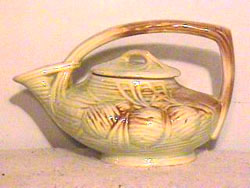
blended glazes. Early designs by Walter Bauer reflected nature in the form
of leaves and berries, and coloration was typically earth tone with browns
and greens. McCoy did not abandon the mass market during this period, continuing
to produce functional pottery in a green glaze in large quantitities. During
the Depression, McCoy banded together with other area potteries to consolidate
marketing and sales for the participants, thus saving money. This organization
was called the American Clay Products Co., and it included the Burley,
Logan, and Crooksville Pottery Companies among others. This cooperative
effort did not work very well, resulting in similar products and more production
than the market could support. In 1933, the company changed its name to
the Nelson McCoy Pottery Company. The 1930s designs introduced some of
McCoy's best known work beyond the floral themes of Walter Bauer, producing
whimsical planters such as The Wishing Well, The Hunting Dog, and Down
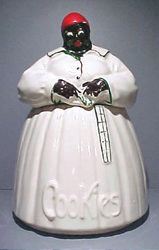
By The Old Mill Stream. They produced primarily cookie jars from about
1940 and into the 1960s, and these cookie jars such as the original "Mammy"
remain extremely popular with collectors today. In the sixties, McCoy went
into a spiral of decline as cheaper overseas imports made it increasingly
difficult for the company to make a profit. McCoy was first sold to The
Mount Clemens Pottery Company in 1967 and later to the Lancaster Colony
Corporation in 1974, and all further production ceased in 1990 and the
company went out of business.
Early McCoy pottery
has a mark which is a circle with a shield inside, and typically
a number which reflects the capacity of the specific container
in gallons. They also
used a clover with a double shield, and an M above it. Most
production after about 1938 has the McCoy mark incised or
embossed on the bottom.
Ever been fooled by
a fake or a seller that didn't deliver the goods as described?
At Collectics, we authenticate and stand behind everything we sell, at
prices "30% below your local antique shop" according
to Collectibles Guide 2010. Please browse our main Antiques
& Collectibles Mall to find a treat for yourself or
a great gift for others, all with free shipping. Thanks for visiting and shopping at Collectics!
Buy
period McCoy Pottery plus Weller, Hull, Rookwood, Van Briggle,
Roseville, and much more on the Collectics Pottery
and Kitchenware
pages, or search the entire site for great antiques, collectibles,
and crafts for every collector!
|
|
|
Cool
Coupons & Promo Coupon Codes for Disney, Brookstone,
Avon, Netflix, eBags, and more @ our Coupon
Site!
|
|
|
|
|
|
Amazon.com:
Earth's Biggest Store!
|
|
|
|
Collector Book Purchases & Advertising Support Our
Free Online Museums, Antiques & Collectibles Information,
and Directories - Thank You! |
|
|
|
|
|
|
|
Display
Cases for collectibles, figurines, diecast
cars, sports memorabilia, dolls, and more!
|
|
|
|
Copyright
© Collectics. All rights reserved.
|
|