|
Antiques,
Collectibles, Vintage Shopping
|
|
|
|
Collector
Books, Reviews, Education
|
|
|
|
Online
Museums & Directories
|
|
|
|
Discover
Collectics Variety
|
|
|
|
Cool
Stuff
|
|
|
|
|
|
|
|
|
Vintage
Sunglasses Shop - Authentic
vintage Revo, Ray-Ban, Armani,
Carrera, Alpina, Cazal, Persol, Vuarnet,
Bolle, Oliver Peoples, and French
cat's eye sunglasses!
|
|
|
|
Collectics
Antique & Vintage Sale
Coupon: Save 10% On Entire Order!
|
|
|
The Collectics
Antiques Information & Education pages are
designed to further knowledge of antiques, collectibles,
collecting styles, periods, artists, designers,
and manufacturers of fine and decorative arts.
To learn more, our Antique
Collector Bookstore lists only the best
collector books and price guides, complied by
surveys of top antique dealers and auction houses.
For a different shopping experience, you can
also browse our featured selections in a fun
new way with the Antique
Price Guides Slideshow or see current Amazon.com
bestsellers by using Collector
Books Topic Search.
|
| "prices 30% below your local antique shop or vintage store plus free shipping." Collectibles Guide 2010 |
| Peanuts
© United Feature Syndicate, Inc.
|
|
|
|
|
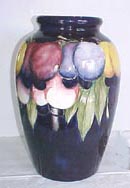
MOORCROFT
POTTERY INFORMATION & HISTORY
|
|
|
Collectics
Customer Appreciation Sale
Coupon: Save 10% On Entire Order!
|
|
| William Moorcroft
was born in 1873 and first began experimenting with his own pottery designs
around 1896 while working for James Macintyre & Co Ltd. William's artistry
and designs were quickly recognized for their quality and innovation. His
first important design was the Aurelian Ware, part transfer and part hand
painted. Very shortly thereafter, around the turn of the century, he developed
his famous Florian Ware, with heavy slip, done in mostly blue and white.
Since the early 1900s there has been a succession of designs, most of them
very characteristic of the company. The 1920s were good years for Moorcroft,
partnering with a well known London store Liberty to offer its unique flambe
glaze pottery to the eager public. In 1929 Queen Mary, who had been collecting
his pottery, made him "Potter to the Queen," and the pottery was so stamped
up until 1949.
Moorcroft went through a Japanese stage
in the early teens with his lovely lustre glazes, oriental shapes, and
decorations. During the mid-teens he began to produce his most popular
Pomegranate Ware and Wisteria (often called 'Fruit'). Around that time
he also designed the popular Pansy line as well as Leaves and Grapes. Soon
he introduced a beautiful landscape series called variously Hazeldine,
Moonlit Blue, Eventide, and Dawn. These wonderful designs along with Claremont
(Mushrooms) seem to be the most sought after by collectors today. During
the 1920s and '30s, Moorcroft became very interested in highly fired Flambe
(red) glazes. These could only be achieved through a very difficult procedure
which he himself perfected in secret. He later passed the knowledge on
to his son.
The richness of the Moorcroft glazes gave
its pottery unusually deep and vivid colors, developed jointly by William
Moorcroft and his son Walter. Walter took over the pottery in 1945 at the
end of World War II and just before William's death in 1946, and he maintained
the tradition of quality and innovation. Moorcroft now moved into a number
of floral designs interpreting the earlier work of Tiffany,
Galle, and others in a new and unique style. Moorcroft was quite prosperous
through most of these times as the public demand for its works remained
high. Fortunes started to change in the 1960s and continued for a number
of years, culminating in the sale of a controlling interest to an outsider
and the beginnings of "mass production." Needless to say, this switch destroyed
the quality reputation of Moorcroft, and subsequent ownership changes into
the early 1990s kept the company in a constant state of flux. Walter Moorcroft
retired in 1987, and Sally Dennis assumed the leadership, beginning a period
of female executives restoring Moorcroft to financial and artistic health.
Rachel Bishop replaced Sally in 1993, and new designs have once again restored
Moorcroft to a position of relevance in fine art pottery.
Dating of this pottery
is done by knowledge of the designs, shapes, signatures, and
marks on the bottom of each piece; an experienced person can
usually narrow it down to a short time frame.
Ever been fooled by
a fake or a seller that didn't deliver the goods as described?
At Collectics, we authenticate and stand behind everything we sell, at
prices "30% below your local antique shop" according
to Collectibles Guide 2010. Please browse our main Antiques
& Collectibles Mall to find a treat for yourself or
a great gift for others, all with free shipping. Thanks for visiting and shopping at Collectics!
Buy
finer ceramics on the Collectics Fine Antiques, Porcelain,
and
Pottery pages, or
search the entire site for great antiques, collectibles, and
crafts for every collector!
Sell
or consign period Moorcroft, Goldscheider, Teplitz Amphora, Royal Doulton,
Staffordshire, and other finer pottery and porcelain at Collectics! Read about our top performing national consignment program for estate and personal collections. |
|
|
Cool
Coupons & Promo Coupon Codes for Disney, Brookstone,
Avon, Netflix, eBags, and more @ our Coupon
Site!
|
|
|
|
|
|
Amazon.com:
Earth's Biggest Store!
|
|
|
|
Collector Book Purchases & Advertising Support Our
Free Online Museums, Antiques & Collectibles Information,
and Directories - Thank You! |
|
|
|
|
|
|
|
Display
Cases for collectibles, figurines, diecast
cars, sports memorabilia, dolls, and more!
|
|
|
|
Copyright
© Collectics. All rights reserved.
|
|