|
Antiques,
Collectibles, Vintage Shopping
|
|
|
|
Collector
Books, Reviews, Education
|
|
|
|
Online
Museums & Directories
|
|
|
|
Discover
Collectics Variety
|
|
|
|
Cool
Stuff
|
|
|
|
|
|
|
|
|
Vintage
Sunglasses Shop - Authentic
vintage Revo, Ray-Ban, Armani,
Carrera, Alpina, Cazal, Persol, Vuarnet,
Bolle, Oliver Peoples, and French
cat's eye sunglasses!
|
|
|
|
Collectics
Antique & Vintage Sale
Coupon: Save 10% On Entire Order!
|
|
|
The Collectics
Antiques Information & Education pages are
designed to further knowledge of antiques, collectibles,
collecting styles, periods, artists, designers,
and manufacturers of fine and decorative arts.
To learn more, our Antique
Collector Bookstore lists only the best
collector books and price guides, complied by
surveys of top antique dealers and auction houses.
For a different shopping experience, you can
also browse our featured selections in a fun
new way with the Antique
Price Guides Slideshow or see current Amazon.com
bestsellers by using Collector
Books Topic Search.
|
| "prices 30% below your local antique shop or vintage store plus free shipping." Collectibles Guide 2010 |
| Peanuts
© United Feature Syndicate, Inc.
|
|
|
|
|
CLARICE
CLIFF CERAMICS, POTTERY, BIZARRE WARE INFORMATION & HISTORY
|
|
|
Collectics
Customer Appreciation Sale
Coupon: Save 10% On Entire Order!
|
|
| Clarice Cliff
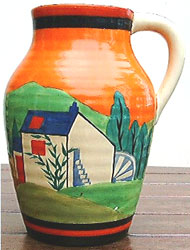
was one of the pioneer designers and decorators of highly stylistic Art
Deco ceramics during the early 1920s as the sleek, modern style
of Art Deco took over Europe and the United States well into the 1930s
and up until World War II. Clarice Cliff used basic pottery shapes which
were clean yet angular in appearance, and then decorated them in vibrant
colors along largely geometric patterns. Clarice Cliff was born in 1899
in the heart of Staffordshire
region of ceramics production in England. Born into a family well schooled
in pottery, she left school at age 13 and started apprenticing with local
potterys in the area. At age 16, she began working for the A. J. Wilkinson
Company in Burslem, England near where she had gorwn up. Colley Shorter,
the managing director of the company, recognized her talent almost immediately
and they soon even sent her to the Royal School of Art in London to continue
developing her skills.
Eventually, the company set up a separate
studio from which she could experiment with new designs. Clarice was always
a talented potter, it was not until 1925 when she was exposed to the Exposition
Internationale of Arts Decoratifs et Industrialies Modernes in Paris that
her creativity came into full bloom. This was the international exhibition
during which the Art Deco and "moderne" style burst onto the international
design scene, and Clarice was fascinated by the geometrically grounded
modern designs being introduced for all the necessary amenities of daily
life. WIlkinson had always encouraged Clarice to design her own lines,
and she was offered an even greater opportunity to create when Wilkinson
purchased the Newport Pottery. Clarice took Newport "blanks" and began
decorating her own unique and whimsical designs.
In 1928, Clarice Cliff
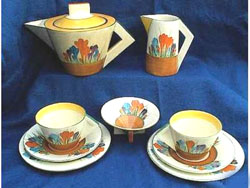
began producing one of her most beloved lines, "Bizarre Ware",
which she continued producing until approximately 1937. She
even had her all-female group of potters known as the "Bizarre
Girls" who traveled the country to trade fairs and shows to
promote the line. Cliff adopted the geometric shapes of Art
Deco, but she also worked in figural shapes including the well
known "Age of Jazz" figures as well as abstract shapes. Her
color decorations were vibrant and included the entire hue of
colors but especially favoring blue, black, orange, and yellow.
Clarice Cliff designs maintained their cheery design aesthetic
with couples dancing and flowers blooming despite the years
affected by the depression in the early 1930s. The floral works
are very strongly collected today, but they were also popular
during the period of production. Additional artisans were hired
to execute Cliff designs by hand on the company's products,
and the "Crocus" pattern became one of her all time best sellers.
The success of Clarice Cliff ceramic designs during this period
gave her great success and peer recognition in the arts world,
still unusual for a woman during the 1930s. In 1939, Colley
Shorter's wife died, and he and Clarice were married in the
following year. In later years, Clarice Cliff designs lost favor
with the public, and the innovation of the twenties and thirties
never returned. She and Colley never had children, and Clarice
Cliff passed away in 1972.
Ever been fooled by
a fake or a seller that didn't deliver the goods as described?
At Collectics, we authenticate and stand behind everything we sell, at
prices "30% below your local antique shop" according
to Collectibles Guide 2010. Please browse our main Antiques
& Collectibles Mall to find a treat for yourself or
a great gift for others, all with free shipping. Thanks for visiting and shopping at Collectics!
Buy
period Clarice Cliff, Rookwood, Roseville, Weller, and other finer art
pottery on the Collectics Pottery
and Art Deco & Art
Nouveau pages, or search the entire site for great antiques,
collectibles, and crafts for every collector!
|
|
|
Cool
Coupons & Promo Coupon Codes for Disney, Brookstone,
Avon, Netflix, eBags, and more @ our Coupon
Site!
|
|
|
|
|
|
Amazon.com:
Earth's Biggest Store!
|
|
|
|
Collector Book Purchases & Advertising Support Our
Free Online Museums, Antiques & Collectibles Information,
and Directories - Thank You! |
|
|
|
|
|
|
|
Display
Cases for collectibles, figurines, diecast
cars, sports memorabilia, dolls, and more!
|
|
|
|
Copyright
© Collectics. All rights reserved.
|
|