|
Antiques,
Collectibles, Vintage Shopping
|
|
|
|
Collector
Books, Reviews, Education
|
|
|
|
Online
Museums & Directories
|
|
|
|
Discover
Collectics Variety
|
|
|
|
Cool
Stuff
|
|
|
|
|
|
|
|
|
Vintage
Sunglasses Shop - Authentic
vintage Revo, Ray-Ban, Armani,
Carrera, Alpina, Cazal, Persol, Vuarnet,
Bolle, Oliver Peoples, and French
cat's eye sunglasses!
|
|
|
|
Collectics
Antique & Vintage Sale
Coupon: Save 10% On Entire Order!
|
|
|
The Collectics
Antiques Information & Education pages are
designed to further knowledge of antiques, collectibles,
collecting styles, periods, artists, designers,
and manufacturers of fine and decorative arts.
To learn more, our Antique
Collector Bookstore lists only the best
collector books and price guides, complied by
surveys of top antique dealers and auction houses.
For a different shopping experience, you can
also browse our featured selections in a fun
new way with the Antique
Price Guides Slideshow or see current Amazon.com
bestsellers by using Collector
Books Topic Search.
|
| "prices 30% below your local antique shop or vintage store plus free shipping." Collectibles Guide 2010 |
| Peanuts
© United Feature Syndicate, Inc.
|
|
|
|
|
ROYAL
HAEGER POTTERY INFORMATION & HISTORY
|
|
|
Collectics
Customer Appreciation Sale
Coupon: Save 10% On Entire Order!
|
|
| David
H. Haeger came to the United States from Germany, founding a small
Illinois company in 1871 that took the original name of the Dundee
Brickyard for the bricks and tile they made to rebuild Chicago
after the great fire as well as other midwestern cities and towns.
However, David Haeger and his son Edmund had aspirations to rise
beyond brickmaking and into a leadership position in the design
and production of art pottery in the U.S. The company first used
its skills with clay in the manufacture of bricks to begin making
small and simple earthenware pots for wholesale and retail sale.
David Haeger died in 1900, but Edmund continued experimenting
with ever more sophisticated designs and glazes, changing the
name of the company to Haeger Potteries.
"Adam
and Eve" was the first art pottery collection introduced by
Haeger about 1912, winning critical acclaim for the richness
of their colors and the quality and lustrous appearance of their
glazes. In 1914, well known artisan Martin Stangl came to work
at Haeger Potteries and further advanced their transition into
a maker of fine art pottery. Stangl came to Haeger from the
Fulper
Pottery Company of New Jersey, known for their innovative forms
and rich, flowing glazes. In fact, many of the new Haeger glazes
he created were considered to be directly analogous to those
he created while at Fulper. In 1919, Stangl went back to Fulper
although Haeger continued to produce his designs and glazes,
and Stangl went on to acquire Fulper during the Depression years
and rename it Stangl Pottery. The 1934 Chicago World's Fair
exposed Haeger work to an international clientele. As Fulper
had done earlier, Haeger constructed a working kiln and pottery
manufacturing facility at the fair for the public to see the
wares in production by the skilled craftsmen.
The
Haeger family continued to be actively involved in the operations,
with Edmund Haeger's son-in-law Joseph Estes becoming the general
manager of the factory in about 1938 and later rising to President
upon Edmund Haeger's death. It was during this time that the
designer Royal Hickman came to Haeger to create the Royal Haeger
line which continues today. Hickman was born in Oregon in 1893
and worked as a designer for Californian and European potteries
before coming to Haeger. Hickman's design aesthetics were flowing
and elegant, and pieces were typically offered in various sizes.
Art
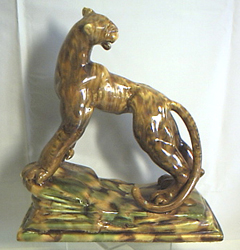
Deco and modern influences were evident in Hickman's Royal
Haeger designs such as the panthers which frequently appeared
in Haeger lamps and decorative pieces. The success of the Royal
Haeger line prompted the company to hire additional name designers
to broaden their creative reach, including Eric Olsen who created
many of the most famous designs such as the Haeger bull until
his retirement in 1972. Other designers of note who did work
for Haeger include Sascha Brastoff and Franz Joseph Koenig.
Hickman himself left the company in 1944 but continued to work
for Haeger as well as other manufacturers such as Heisey into
the 1950s.
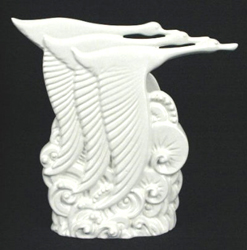
Royal
Haeger is still best known for their animals, birds, and other
figurines as well as the manifestations of these designs in
lamps and lighting. Haeger is probably the best known manufacturer
of 1950s TV
lamps which have emerged as a major collecting area in themself.
Still a family operation, Alexandra Haeger Estes (Joseph's daughter
and great granddaughter of founder David Haeger) became President
of Haeger Potteries in 1979. Much of Haeger's production is
unmarked or had paper labels which most often came detached
or were removed, so it is not unusual to find unrecognized Haeger
pieces at bargain prices through flea markets and estate sales.
Ever been fooled by a
fake or a seller that didn't deliver the goods as described?
At Collectics, we authenticate and stand behind everything we
sell, at prices "30% below your local antique shop"
according to Collectibles Guide 2010. Please browse our main
Antiques & Collectibles
Mall to find a treat for yourself or a great gift for others,
all with free shipping. Thanks for visiting and shopping at
Collectics!
Buy
period Art Deco decorative arts on the Art
Deco & Art Nouveau and Fine Antiques pages.
Buy
period Royal Haeger, Hull, Metlox, McCoy, and more great American art pottery
on the Collectics Pottery
pages, or search the entire site for great antiques,
collectibles, and crafts for every collector!
|
|
|
Cool
Coupons & Promo Coupon Codes for Disney, Brookstone,
Avon, Netflix, eBags, and more @ our Coupon
Site!
|
|
|
|
|
|
Amazon.com:
Earth's Biggest Store!
|
|
|
|
Collector Book Purchases & Advertising Support Our
Free Online Museums, Antiques & Collectibles Information,
and Directories - Thank You! |
|
|
|
|
|
|
|
Display
Cases for collectibles, figurines, diecast
cars, sports memorabilia, dolls, and more!
|
|
|
|
Copyright
© Collectics. All rights reserved.
|
|