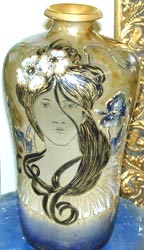
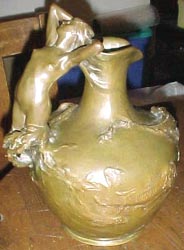
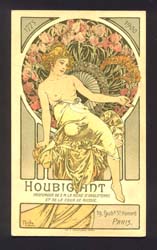
| Alphonse Mucha
is synonomous with the aesthetics of the Art Nouveau movement in France
at the turn of the century. Originally from Czechoslovakia, Mucha was an
unknown artist when he was tapped in 1984 to create a design graphic of
the most famous actress of the time, Sarah Bernhardt. Mucha's interpretation
of Bernhardt was wildly popular and reflective of a style so clearly new
and revolutionary that Europeans of all countries recognized the distinctive
look and concept. Alphonse Mucha was born in 1860 in Moravia, now part
of the Czech republic. He painted murals and oils in traditional historical
and religious motifs on commission from many sources, but he aspired to
be a serious artist and pursued formal training in Prague and Munich. Soon
thereafter, Mucha moved to Paris in 1887 and was exposed to the vitality
of the French capital. Whlie partially supported by a wealthy patron, Mucha
was also forced to take on many smaller commissions including illustrations
for books, magazines, and calendars.
When Sarah Bernhardt was looking for an
artist on very short notice to help promote her new play Gismonda, Mucha
lept at the chance for such exposure. While even his printer was reluctant
to send such an unconventional style to so prominent a personality, he
ultimately did and Bernhardt loved it. As it turned out, so did the public.
Mucha and Bernhardt maintained their relationship for many years, and he
designed stage sets, costumes, publicity, and jewelry for Bernhardt's many
productions. Paris during this period was a very exciting time, when the
traditionalism of the Victorian period was giving way to a more indulgent,
luxurious time when excesses where the norm. These unhibited times were
perfect for Mucha, who loved women and the female form. Curvaceous lines
are typical of Mucha's women and of his work, reflected in many ways in
how he stylized women and introduced abstractions to go beyond what the
eye could see. Mucha was not an elitist artist; he allowed his art to be
used on a wide variety of functional and decorative objects. The print
shop Champenois had a contract with Mucha which allowed virtually unlimited
quantities of panels, posters, calendars, and illustrations to be produced
to meet public demand. The output was extremely diverse in both form and
in quality, ranging from mass production prints to fine, limited editions.
One of Mucha's most famous works is the zodiac calendar, popularized as
the La Plume calendar. La Plume was a magazine which purchased the rights
to the calendar design from Champenois, who was using it on one of their
in house calendars. When popularized subsequently in La Plume, it was widely
recognized and liked, and it became synonomous with the magazine.
The Art Nouveau period spans roughtly 1895-1914
and resulted in an international style based on decoration. While Mucha
was a pioneer, many artists contributed to the development of the style
during this period such as Louis
Comfort Tiffany,
René Lalique, Emile Galle, and others, ushering in the modern, urban era.
Art Nouveau exploded on the scene at the Paris World's Fair (Exposition
Universelle) in 1900, drawing 48 million visitors. There, Siegfried Bing
and owner of the shop L'Art Nouveau in Paris introduced the world to furniture,
jewelry, ceramics, posters, glass, textiles, and metalwork. The American
dancer Loie Fuller was also present at the fair, whose erotic dances with
veils later inspired lamps and other decorative objects of the period.
Nature was the most common theme among
artists of this period, inspired by Charles Darwin's Origin of the Species
in 1859 and The Descent of Man in 1871, linking human beings inextricably
to nature. René Lalique interpreted this discovery in his jewelry, often
combining the female form with flowers and insects from the natural world.
The French town of Nancy was also a center of the Art Nouveau movement,
the workplace of Emile Galle, an accomplished botanist who used flowers
and insects on his cameo glass just as René Lalique did with his jewelry.
Furniture and lighting also came to embody the Art Nouveau style with the
sinuous forms of Louis Majorelle and others. Cast iron and the print media
also captured the flowing lines of this style, especially the work of Henri
Guimard on the Paris Metro and the posters of Henri de Toulouse-Lautrec.
Art Nouveau was literally
a worldwide design movement, from the work of Victor Horta,
Henry van de Velde, and Gustave Serrurier-Bovy in Brussels,
Charles Rennie Mackintosh in Scotland, and Louis Comfort Tiffany
in the U.S. In Vienna, Art Nouveau was known as the Secession
style and was associated with the Viennese artist Gustav Klimt.
In 1903, Josef Hoffmann and Koloman Moser, members of the Secession
group, founded the Vienna Workshops which respected the principles
of craftsmanship developed in severak years earlier in Scotland
with Mackintosh and with historical Japanese designs. In Germany,
Art Nouveau was known as Jugendstil, or Youth Style, and was
practiced by such notable designers as Otto Eckmann, Richard
Riemerschmid, and Hermann Obrist. In Italy, Carlo Bugatti was
a leading practitioner of what was known as the "stile floreale"
in his eclectic furniture designs. In New York, the Industrial
Revolution had given rise to wealthy businessmen and philanthropists,
whose patronage of the arts led to major public museums, libraries,
and mansions in the Art Nouveau style. The most prominent of
these was Louis Comfort Tiffany, who pioneered an amazing variety
of visually stunning and technically advanced glass and pottery
techniques in his work. It is interesting to note that he originally
began to create lamps in order to use the leftover glass from
the production of windows, and LCT never considered lamps to
be the focus of his artistic endeavors although they have certainly
achieved that status today.
Ever been fooled by
a fake or a seller that didn't deliver the goods as described?
At Collectics, we authenticate and stand behind everything we sell, at
prices "30% below your local antique shop" according
to Collectibles Guide 2010. Please browse our main Antiques
& Collectibles Mall to find a treat for yourself or
a great gift for others, all with free shipping. Thanks for visiting and shopping at Collectics!
Buy
period Art Nouveau antiques on the Collectics Art
Deco & Art Nouveau and Fine Antiques pages, or
search the entire site for great antiques, collectibles, and
crafts for every collector!
Sell
or consign period Art Nouveau bronze, glass, porcelain, and lamps at Collectics!
Read about our top performing national consignment program for estate and personal collections. |