| The art of
enameling dates back many thousands of years. A variation of the technique
was used by the ancient Egyptians, who used filigree metalwork to set not
enamels but rather precious and semi-precious genstones. One of the most
famous examples of this use is the gold mask of Tutankhamun, with its intricate
design and brilliant colors. Unlike jewelry of precious gemstones, enameled
jewelry derived its value from the intricacy of design and skill of the
artist and crafttsmen. This emphasis of design over the rarity of the material
was a key driver of the Art Nouveau movement as well as the English and
American Arts
& Crafts movements. Most styles of enameling are still referred
to by their French names.
The art of plique-a-jour enameling of fine
jewelry burst onto the public scene during the Art Nouveau period with
the work of master jeweler René Lalique at the turn of the century. At about the same time, Russian
jeweler Peter Carl Fabergé, born in 1846, was just becoming famous.
He learned his art working at the Hermitage, the storehouse for all of
the Russian czars where he did repairs as well as appraisals and inventories.
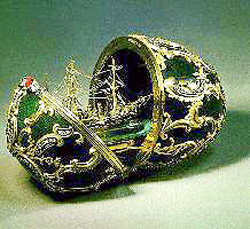
His best known works are the famous Fabergé eggs made as gifts for
the Czar, made of intricate gold forms inlaid with the vivid rainbow of
enamel colors for which his work is so unique. Faberge exhibited his work
at a fair in Moscow where Czar Alexander III and his wife, Czarina Maria,
saw Faberge's skill in enamel work, and he made a purchase and presented
him with a gold medal honoring him as "having
opened a new era in jewelry art." The
House of Fabergé employed the most skilled artisans in the world
although it is interesting that Fabergé himself never made any of
the famous eggs.
First popular with the public in the late
19th century, plique-a-jour is a difficult technique and requires the ability
to create the finest filigree of gold, silver, and copper entirely by hand,
and then to apply the brilliant colors of vitreous, glass like enamel which
fuses with the metal. The metalwork forms an intricate frame or skeleton
into which the enamels are applied, but there is no backing material to
the frame so the enamels have to fuse with the metal to create the finished
surface. Plique-a-jour jewelry is most often created commencing with a
thin sheet of gold or silver. The sheet is pierced or cut using fine art
specialty tools to create the pattern into which paste enamels will be
applied. Where a backing material is used, it is later removed by dissolving
or polishing after the piece is completed. Another lesser used technique
in the manufacture of plique-s-jour is to suspend wires in soft molten
clear enamel which rests on a copper base. This assembly is subsequently
enameled in the chosen colors and the base is removed.
A technique closely
related to plique-a-jour is cloisonné. Cloisonné
is created by attaching strips of gold, silver, or brass
to a metal base. This builds up an intricate grid of "cloisons",
or cells, into which the enamel, often in paste form, is applied.
The network of cloisons also helps separate the colors, allowing
for intricate, colorful work. When the enamel is set, the enamel
is ground to a smooth finish and polished to a brilliant luster.
Repeated firings are used which gradually build up the depth
of the enamel to the desired thickness until you can still faintly
see the outline of the cloisonns within the enamel. Said to
originate in Britain, the champlevé technique is to fill
recesses in the metal made by casting or engraving opaque red,
blue, green, or white enamels. The piece is then polished to
be even with the cells analogous to the finishing performed
on plique-a-jour or cloisonné. Another related
technique is basse-taille, in which a base metal such as silver
or gold is engraved, then covered with a clear enamel through
which one can see the metal engraving.
Ever been fooled by
a fake or a seller that didn't deliver the goods as described?
At Collectics, we authenticate and stand behind everything we sell, at
prices "30% below your local antique shop" according
to Collectibles Guide 2010. Please browse our main Antiques
& Collectibles Mall to find a treat for yourself or
a great gift for others, all with free shipping. Thanks for visiting and shopping at Collectics!
Buy
period finer enamel jewelry and accessories on the Collectics Jewelry
and Fine Antiques pages,
or search the entire site for great antiques,
collectibles, and crafts for every collector!
|