|
Antiques,
Collectibles, Vintage Shopping
|
|
|
|
Collector
Books, Reviews, Education
|
|
|
|
Online
Museums & Directories
|
|
|
|
Discover
Collectics Variety
|
|
|
|
Cool
Stuff
|
|
|
|
|
|
|
|
|
Vintage
Sunglasses Shop - Authentic
vintage Revo, Ray-Ban, Armani,
Carrera, Alpina, Cazal, Persol, Vuarnet,
Bolle, Oliver Peoples, and French
cat's eye sunglasses!
|
|
|
|
Collectics
Antique & Vintage Sale
Coupon: Save 10% On Entire Order!
|
|
|
The Collectics
Antiques Information & Education pages are
designed to further knowledge of antiques, collectibles,
collecting styles, periods, artists, designers,
and manufacturers of fine and decorative arts.
To learn more, our Antique
Collector Bookstore lists only the best
collector books and price guides, complied by
surveys of top antique dealers and auction houses.
For a different shopping experience, you can
also browse our featured selections in a fun
new way with the Antique
Price Guides Slideshow or see current Amazon.com
bestsellers by using Collector
Books Topic Search.
|
| "prices 30% below your local antique shop or vintage store plus free shipping." Collectibles Guide 2010 |
| Peanuts
© United Feature Syndicate, Inc.
|
|
|
|
|
ARTS
AND CRAFTS PERIOD & MISSION STYLE INFORMATION & HISTORY
|
|
|
Collectics
Customer Appreciation Sale
Coupon: Save 10% On Entire Order!
|
|
| The arts and
crafts movement in America was a time of great design experimentation and
innovation in the "craftsman style." Architects such as Frank Lloyd Wright,
Gustav Stickley, and Greene & Greene embraced the clean lines and simplicity
of design emblematic of the arts and crafts style. The Arts & Crafts movement really began in Europe in the latter half of the 1800s alongside
the eroticism and floral themes of Art Nouveau and the German Jugendstil
movement. In the latter years of the 19th century, artists and architects
began to rebel against the dehumanizing effects of industrialization and
return to more hand crafted decorative items. Artist colonies were founded
to explore individual craftsmanship and creativity.
One of the early results of the movement
in America was Mission furniture, first popularized by Gustav
Stickley (1858-1942). Stickley's designs were rustic in design and
used thick, bold framing with a very angular design. Stickley and his contemporaries
in mission furniture used thick planks of oak with large, exposed joints
which were often pegged to give the furniture extraordinary strength and
stability. Rather than the gloss of the Art Nouveau movement, arts &
crafts designs were intentionally rustic and weatherbeaten in appearance.
Special finishes were developed by Stickley and others to age the look
of the wood in their production of mission furniture. Stickley also produced
homes and began publishing Craftsman Magazine in 1901. Stickley designed
homes to fit the furniture he created. Simple "Craftsman-style" homes --
often no more than a few spacious rooms whose only ornamentation consisted
of beautiful natural woodwork and room dividers along with a stone or brick
hearth. An abundance of windows to let in natural light was also important
since sunlight cast an entirely different light than gas and electric lights.
Stickley designs never compromised quality and were expensive to manufacture,
and the firm went bankrupt in 1917 as World War I was ending.
Arts and crafts pottery
also exploded onto the American scene at the turn of the century,
led by manufacturers such as Grueby,
Weller,
Fulper,
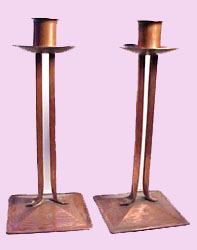
and others. Metalwork also experienced a design renaissance,
as homeowners sought hand forged metalware for use around the
home and in their furniture designs. Copper became a very popular
design material, especially the "hand hammered" look which revealed
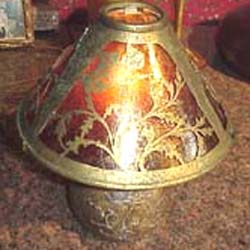
the individual blows of the hammer. Arts and crafts lighting
used bronze, metal, and mica shades to create a new design aesthetic
in lamps. Best known for lamps is Dirk
van Erp, whose hammered copper lamp bases which were patinated
with rich reds and browns were very popular and expensive even
at the time. Roycroft produced many copper bookends, vases,
and other household items, and even Tiffany
produced desk sets and other items in the arts and crafts style.
When Elbert Hubbard, the founder of Roycroft, died in 1915 on
the Lusitania, the American Arts & Crafts movement began
a slow decline. Modernism and Art
Deco was on the rise, maintaining the streamlined design
aesthetic but returning to the use of luxury materials and design
extravagance.
Ever been fooled by
a fake or a seller that didn't deliver the goods as described?
At Collectics, we authenticate and stand behind everything we sell, at
prices "30% below your local antique shop" according
to Collectibles Guide 2010. Please browse our main Antiques
& Collectibles Mall to find a treat for yourself or
a great gift for others, all with free shipping. Thanks for visiting and shopping at Collectics!
Buy
antiques & collectibles from the Arts & Crafts period on the Collectics
Fine Antiques, Pottery,
Bronze & Metal,
and Lamps & Lighting
pages, or
search the entire site for great antiques, collectibles, and
crafts for every collector!
Sell
or consign finer antiques from the Arts & Crafts period like Stickley,
Roycroft, and Dirk van Erp at Collectics. Read about our top performing national consignment program for estate and personal collections. |
|
|
Cool
Coupons & Promo Coupon Codes for Disney, Brookstone,
Avon, Netflix, eBags, and more @ our Coupon
Site!
|
|
|
|
|
|
Amazon.com:
Earth's Biggest Store!
|
|
|
|
Collector Book Purchases & Advertising Support Our
Free Online Museums, Antiques & Collectibles Information,
and Directories - Thank You! |
|
|
|
|
|
|
|
Display
Cases for collectibles, figurines, diecast
cars, sports memorabilia, dolls, and more!
|
|
|
|
Copyright
© Collectics. All rights reserved.
|
|