|
Antiques,
Collectibles, Vintage Shopping
|
|
|
|
Collector
Books, Reviews, Education
|
|
|
|
Online
Museums & Directories
|
|
|
|
Discover
Collectics Variety
|
|
|
|
|
|
|
|
|
Vintage
Sunglasses Shop - Authentic
vintage Revo, Ray-Ban, Armani,
Carrera, Alpina, Cazal, Persol, Vuarnet,
Bolle, Oliver Peoples, and French
cat's eye sunglasses!
|
|
|
|
Collectics
Antique & Vintage Sale
Coupon: Save 10% On Entire
Order!
|
|
|
|
Thanks
to the top antique dealers and private collectors
who allow us to feature their collections in
our online museum gallery, featuring the Art
Nouveau, Art Deco, and Arts & Crafts design
periods of the early 20th century. Among others,
we feature the work of Louis Comfort Tiffany,
Handel, Pairpoint, Galle, Loetz, Lalique, Demetre
Chiparus, Bruno Zach, Frankart, Stickley, Roycroft,
Rookwood, Newcomb, Grueby, and Turn Teplitz
Amphora. These pieces are not for sale and are
displayed here along with reference information
to be fun and educational. Continue learning
about finer antiques and collectibles on the
Collectics Antiques
Information & Education program pages,
and find the best collector reference books
and antique price guides in the Antique
Collector Bookstore.
Find
out why Collectibles Guide 2010 calls
Collectics the "best online shopping for antiques
and collectibles with prices 30% less than your
local antique shop or thrift store." Explore
our eclectic selection of antique and vintage
pottery, porcelain, glass, memorabilia, bakelite
& lucite, vintage jewelry and accessories,
and more in our main Antique
& Vintage Shop and Mall.
Can't
decide what to buy or need a great gift? Collectics
Gift
Certificates let your recipient select something
they really want from our extensive selection
of antiques, collectibles, and the best antique,
vintage, and retro jewelry and home furnishings
for sale online- all with free shipping! Thanks
for visiting and shopping at Collectics!
|
| Explore
the Antiques & Collectibles Mall |
|
|
|
Photo
click to enlarge
|
Art
Deco, Art Nouveau, and Arts & Crafts Design Museum 1890-1935:
Gallery
2
|
Museum Pages:
Gallery
1, Gallery 2, Gallery
3, Gallery
4, Gallery
5
Related Bookstore
Pages: Tiffany
Studios, Lamps
& Lighting, Art
Deco/ Nouveau/ Arts & Crafts, American
Pottery, Pottery,
Glass
& Crystal, Porcelain
& China,
Silver
& Metalware
|
|
Collectics Antique & Vintage Coupon
Code: Save 10% On Entire Order!
|
|
Save
& Learn!
|
Schiffer:
The Antique Collector Books & Price Guides Dealers
Use!
|
|
photo
3
photo
4
photo
5
photo
6
photo
7
photo
8 |
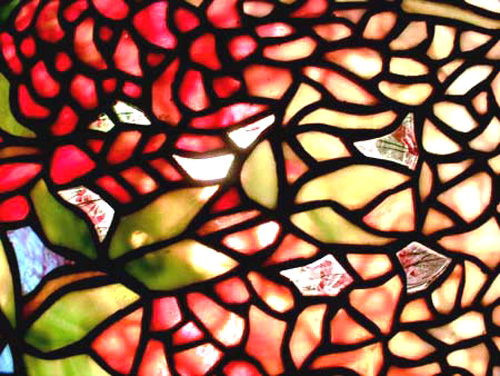
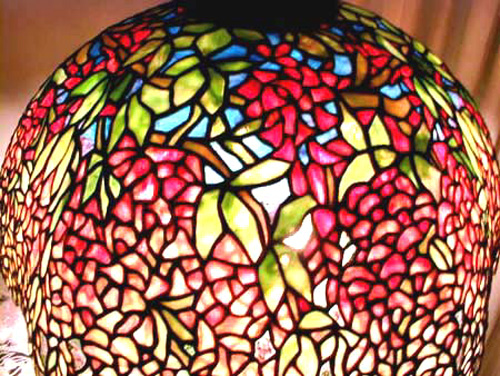
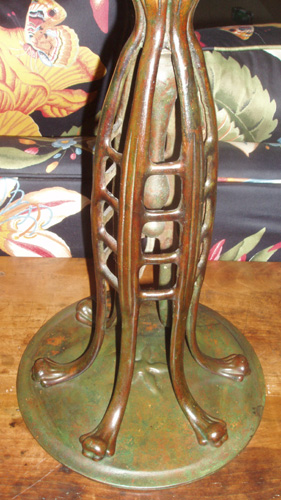
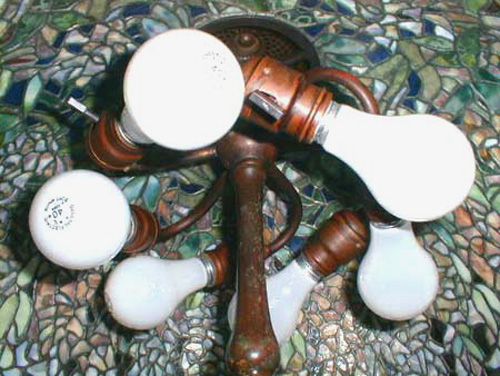
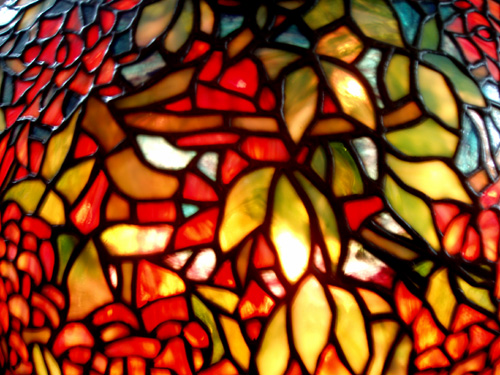
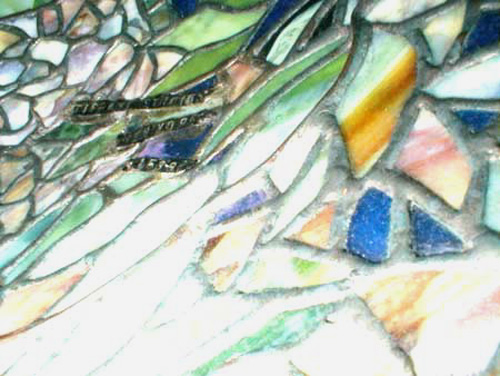
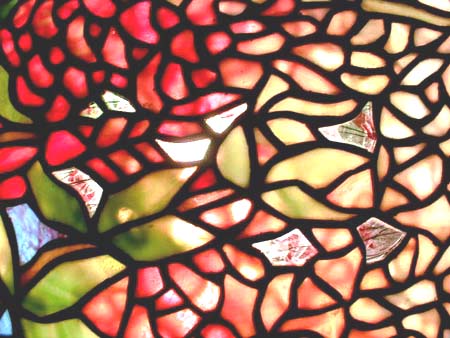
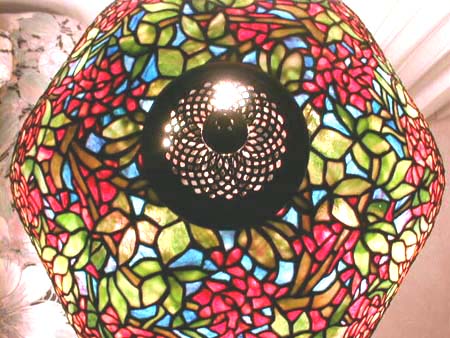
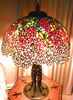
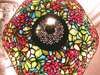
This rare
Tiffany Studios Laburnum shade c. 1905 is one of the largest ever
produced at 24" in diameter and is a 6 ribbed shade using the
Tiffany Studios 1538 "block". All period Tiffany lamps were constructed
using one of many frames from which the leaded shade was created
and assembled, and there are copper strands imbedded in the leading
that is one of the ways experts catch Tiffany lamp reproductions.
The ribbed effect gives added realism to this shade as an embodiment
of nature, amplifying the effect of color and texture inherent
in the glass. Rivaled only by the Nasturtium, the Laburnum shade
is comprised of hundreds of tiny pieces of Tiffany favrile glass
including the very rare and clear confetti glass which you can
see in the close up photograph. The use of the small shards of
clear confetti glass has the effect of light passing through the
densely packed leaves and flowers of the plant. The Tiffany Studios
bronze "cat's paw" base has an excellent green patina and is also
one of the largest produced, with 6 lights and rising to a total
height of 33". The shade is properly marked Tiffany Studios New
York 1538, but note how the metal tag is within the body of the
shade as opposed to along the lower edge as is common. This of
course is mandated by the wonderful and irregular bottom edge
of this fine leaded glass shade. In the Tiffany catalogue of 1906,
this shade was one of the most expensive offered at $225 for the
shade alone, and that was a lot of money in 1906! Reference
Source: Lamps
of Tiffany by
Egon Neustadt |

Lamps
of Tiffany
 |
photo
3
photo
4 |
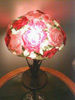
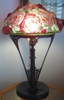
A Pairpoint
Puffy rose bouquet lamp c. 1910 standing 20.5" high. The Puffy
shade is approximately 14" wide at the widest point and approximately
8.5" wide at the bottom opening which inserts into the bronze
base ring. The bronze base is decorated with floral details and
retains most of the original paint highlights to the flowers and
has the original patina. Properly marked on the base; the shade
is not marked but is common in Pairpoint puffys due to the rubbing
of the shade as it is inserted into the base ring over the years.
Pairpoint Manufacturing Company began in 1880 in New Bedford,
MA. Puffy shades were molded glass and were produced until the
1930s. Learn more about Pairpoint lamps on the Collectics Reference
& Education Program Pairpoint
Lamps page. Reference
Source: Pairpoint
Lamps by Edward Malakoff, Sheila
Malakoff |

Pairpoint
Lamps
|
photo
3 |
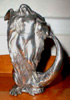
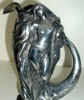
Polished
pewter Art Nouveau figural ewer 6.25" high and signed J.
Sole. Ewer is decorated with a woman in the typical Art Nouveau
style, clinging to the side of the pitcher. The piece is French
and c.1900. The bottom is marked "Etain Garant" and underneath
"pur Paris." I liked the theme of this piece and the slightly
irregular shape to the ewer. |
|
photo
3
photo
4
photo
5
photo
6
photo
7 |
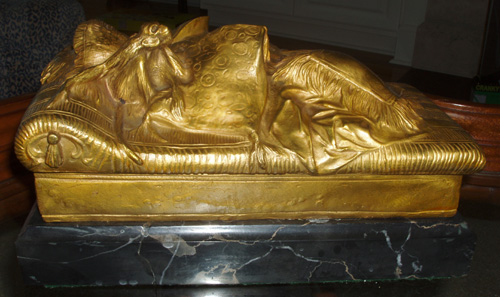
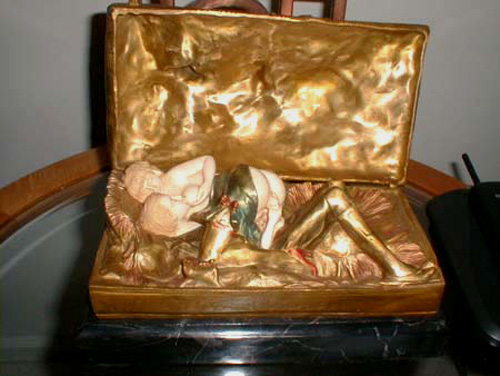
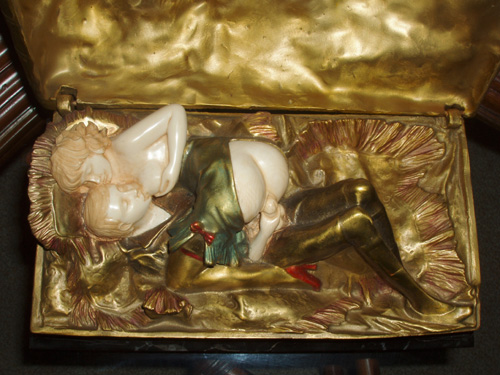
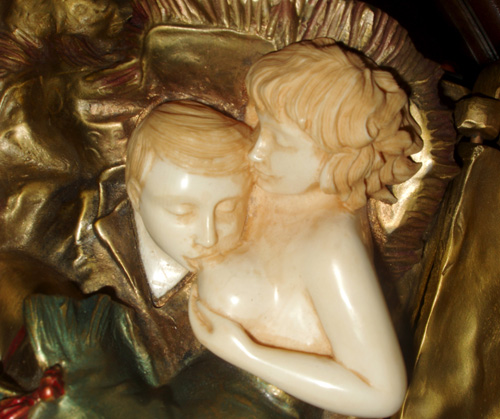
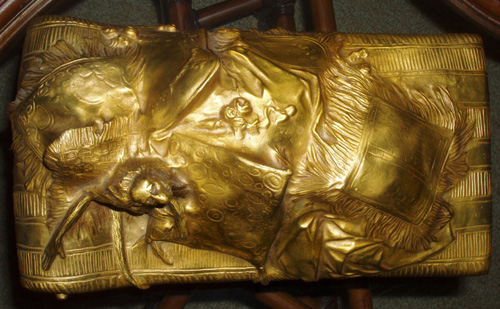
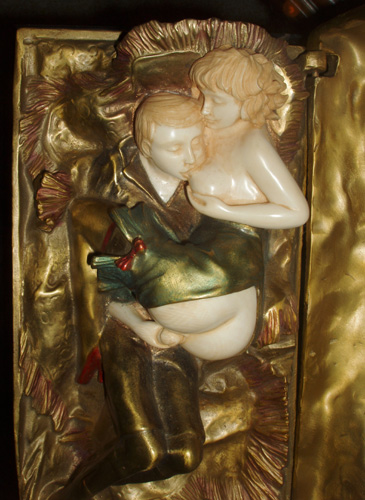
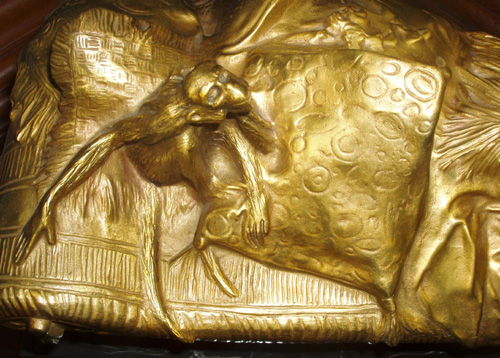
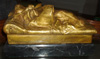
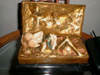
Period Bruno Zach erotic
bronze box on a period black marble base c. 1920. The top of
the gilded bronze box depicts a monkey sitting whimsically atop
an Egyptian day bed. Note the rise in the covers and throw pillows.
When opened, the interior depicts an erotic scene (caution:
photo 3) of a young man and woman executed in cold painted
bronze and ivory. The veined black marble base measures 11"
long, 6" wide, and rises 1.5" high. The complete work is 6.25"
tall with the box closed. Reference
Source: Forbidden
Art: The World of Erotica (Schiffer Book for Collectors)
by Miss
Naomi
|

Forbidden
Art: The World of Erotica (Schiffer Book for Collectors)
|
 
photo
3 |
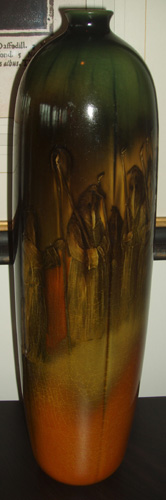
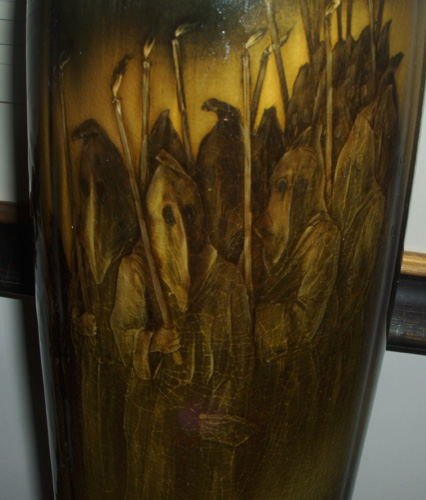
Rookwood
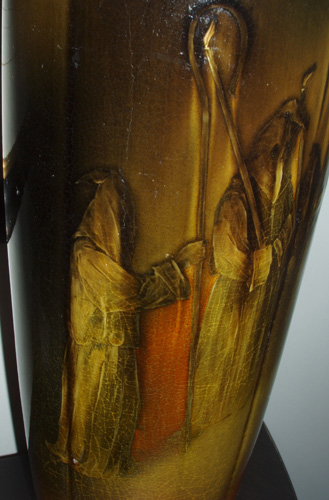
Pottery vase produced in 1891 and standing a full 19" high.
This early piece was done in the Standard glaze with a very large
scenic depiction by the artist of Spanish monks holding their
staffs. The founder of Rookwood, Maria Longworth Nichols, made
a trip to Spain about this time, and it is believed that this
one of a kind piece was produced shortly thereafter. The bottom
is properly marked with the Rookwood mark surrounded by flame
marks indicating production in 1891. There is a small chip on
the bottom of the vase which has taken away most of the artist's
mark so it cannot be definitively determined who the artist was.
However, Rookwood employed only a few fine artists in this early
period, and it is clear that this painting represents outstanding
work. A rare piece of history correlated with the life of the
founder of Rookwood captured in a fabulous painting.
Reference
Source: Rookwood
Pottery: The Glaze Lines With Value Guide
by Anita J. Ellis
|
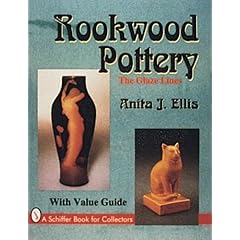
Rookwood
Pottery: The Glaze Lines With Value Guide
|
|
|
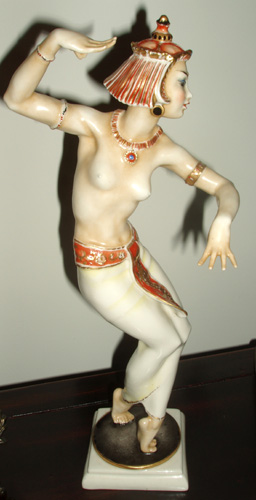
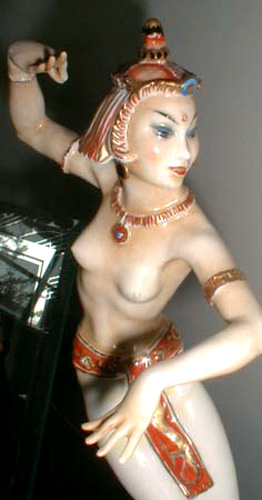
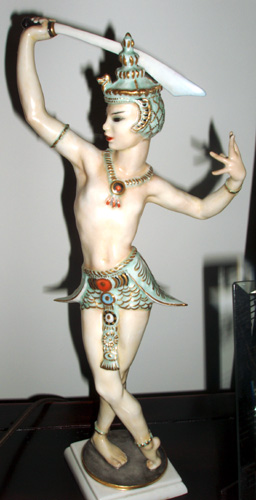
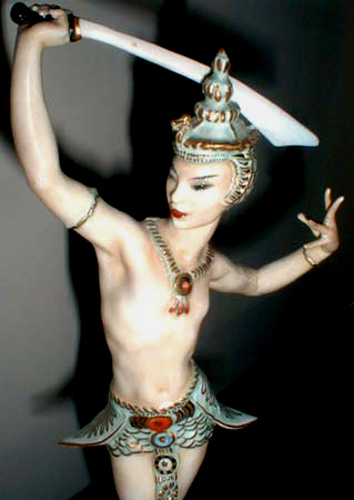
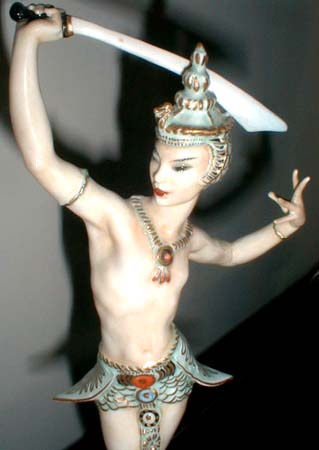
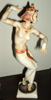
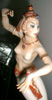
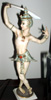
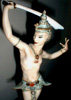
Hutschenreuther male
and female porcelain Art Deco dancers c. 1930. Each figure stands
approximately 11.5" high, and the bottom is marked with the
Hutschenreuther Helb logo of a lion and underneath LHS. Additional
markings are "Kunstabteilung" and "Germany." Both pieces both
have the original sales stickers attached to the bottom as well.
Great design, color, and detail. Note that each finger on each
hand is individually done on these pieces, not grouped together--
a sure sign of quality porcelain making technique. Reference
Source: Art
Deco & Other Modernist Ceramics
by Karen McCready
|

Art
Deco and Modernist Ceramics |
photo
3 |
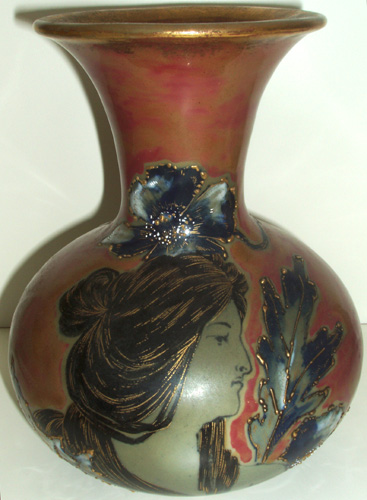
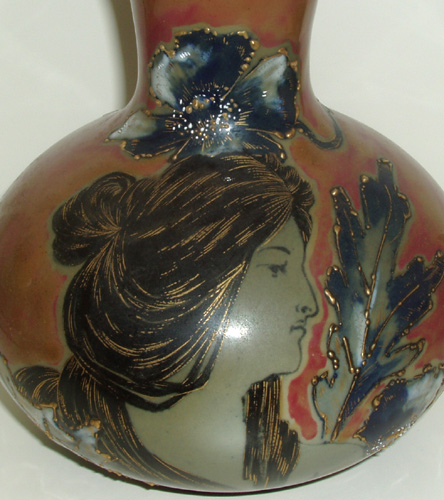
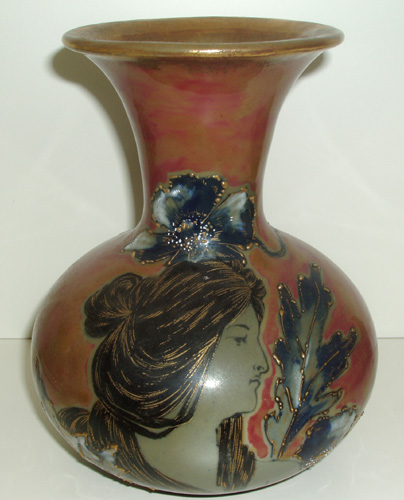
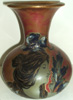
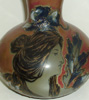
Stellmacher
(R. St. K.) Teplitz amphora
vase c. 1910 standing 6.5" high with a Mucha woman hand
painted on the front and raised gold highlights typical of the
manufacturer. The bottom has the red R. St. K. mark, Turn-Teplitz,
the numbers 474 1, and the artist's initials N.K. Few Teplitz
pieces bear the artist's signature, although many fine artists
worked in the Turn-Teplitz area of Bohemia during this period.
Learn the history of Alphonse Mucha and his influence on the times
on the Collectics Education Program History
of Art Nouveau page. Reference
Source: Art
Nouveau, 1890-1914 by Paul Greenhalgh
|

Art
Nouveau, 1890-1914
|
 |
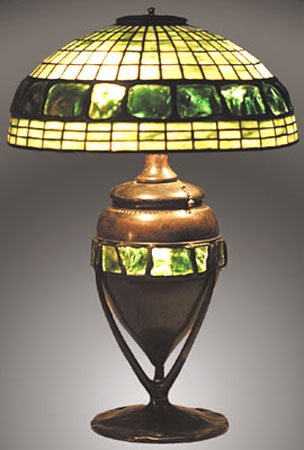
Unusual Tiffany Turtleback
shade and base make this lamp truly special, with 16.0" diameter
shade and standing 22.0" high. Three rows of mottled green/white
glass leads to a wide band of emerald green turtleback glass
with iridescent blue highlights. Five more rows of green/white
mottled glass complete this dramatic shade held on the
torpedo base by three arms and a center stem. Inserted in the
center is another wide band of turtleback glass, which can be
lit separately from within. The top of the torpedo is pierced
with tiny teardrop holes. A desirable multicolored patina is
found on all metal, and the base is signed Tiffany Studios,
New York 9535. Reference
Source: Louis
Comfort Tiffany and Laurelton Hall: An Artist's Country Estate
by Alice Cooney
Frelinghuysen
|

Louis
Comfort Tiffany and Laurelton Hall: An Artist's Country Estate
|
photo
3 |
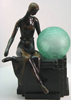
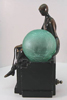
Sought after
by Frankart and Nuart collectors, this signed Frankart lamp #
L262 is properly marked Frankart, Inc...Pat Appld For and designed
by Louise Cross in 1931 for Frankart. The style is very moderne
and features a lovely green crackle glass ball shade, and measuring
7.75" high, 4.75" wide, and 4.0" deep. Since Frankart pieces were
made of "pot metal" and finished, it's not unusual to see significant
wear on original pieces. However, this is still far preferable
to repainting or refinishing them from a Frankart collector standpoint.
Most of Frankart's Art Deco sculptures, lamps, ashtrays, and vases
were the work of sculptor Arthur Frankenberg, who established
the business in New York City in the early 1920s and produced
works only until the early 1930s. Reference
Source: Art
Deco: 1910-1939 by Tim
Benton, Charlotte Benton, Ghislaine Wood |

Art
Deco: 1910-1939
|
|
photo
3
photo
4
|
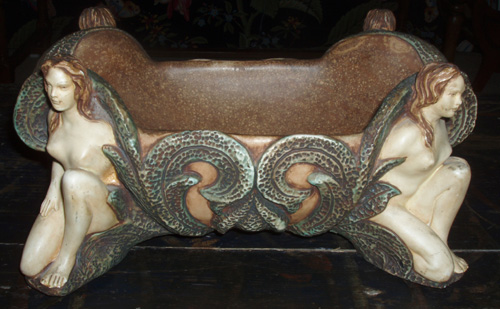
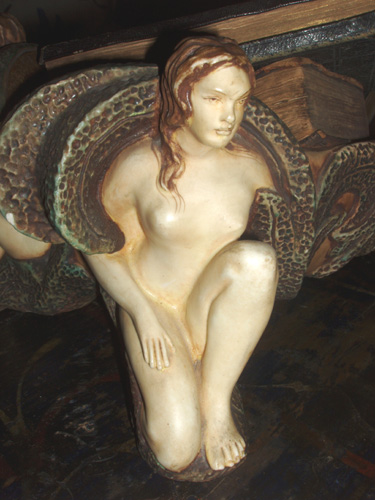
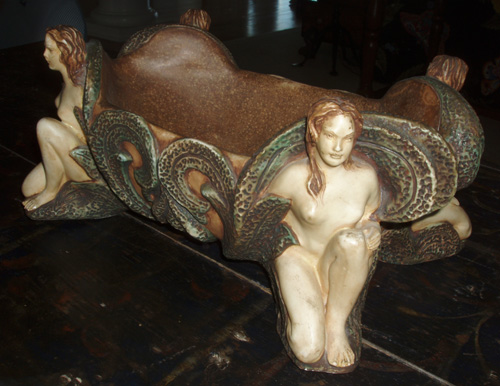
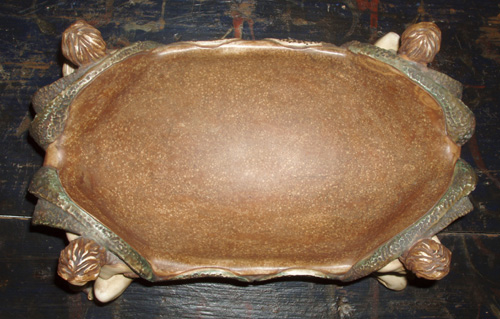
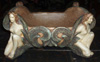
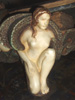
Czechoslovakian
amphora figural bowl c. 1900. Four nude women guard the four corners
of the bowl; the piece stands 8.5" high and 12.5" long. The bottom
is marked with the number 20134 and the letter I, plus "Amphora"
and "Made in Czechoslovakia". A fine example of the upper limit
of Czech amphora from the Art Nouveau period. |
|
 |
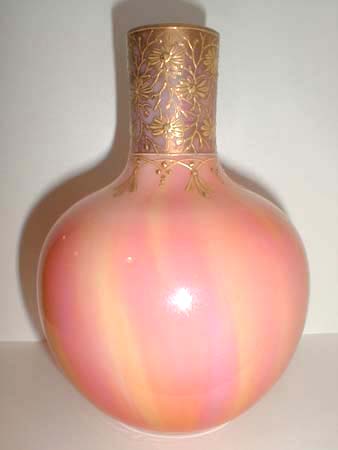
Rare New England peachblow
vase c.1890 with gold trim 6.25" high. Strong swirling colors
and highly detailed gold decoration represent the upper tier
of peachblow art. Peachblow, or "Peach Blow", glassware first
became popular in the latter part of the 19th century, and many
manufacturers moved quickly to meet the public demand, some
say created by an auction in the late 1800s of an ancient Chinese
vase with the unusual color typified by peachblow glass. Production
of peachblow glassware can be categorized into three groupings-
Wheeling, Mt. Washington, and New England of which this is an
example. Each type shades slightly different colors top to bottom
and also differ in whether or not they were lined. New England
peachblow shades from rose pink at the top to a white toward
the bottom, and like Mt. Washington work it is not lined. This
is an example of New England peachblow but clearly an expensive
piece even in its day with the ornate top gilding. Reference
Source: The
Corning Museum of Glass: A Decade of Glass Collecting by
David Whitehouse, Corning Museum of Glass
|

The
Corning Museum of Glass: A Decade of Glass Collecting
|
|
photo
3
|
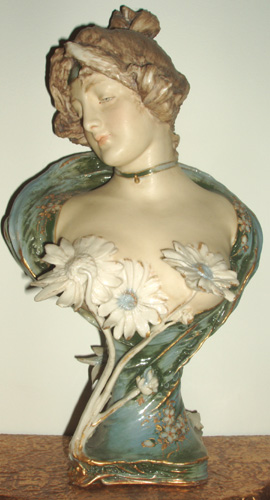
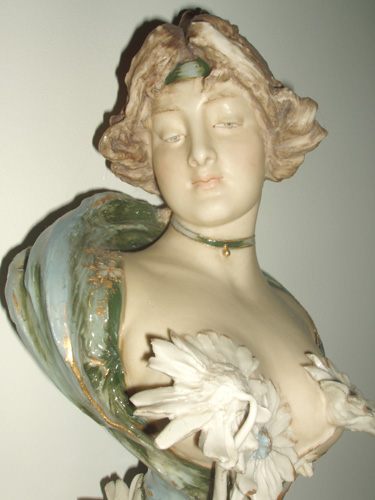
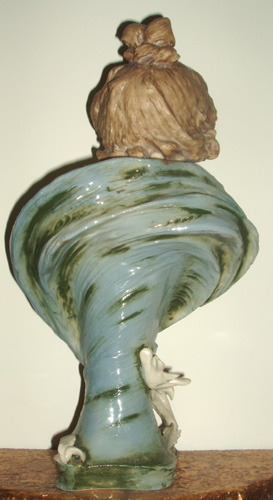
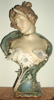
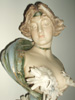
Turn-Teplitz
amphora female bust by the Reissner Stellmacher & Kessler
(R St. K) amphora works in Turn-Teplitz, Austria c. 1900. Reissner
is recognized as one of the premier makers of Teplitz and clearly
Art Nouveau. The base is properly marked with the red R St. K
factory mark as well as 1637W and the impressed numbers
198 9. The bust stands 12.5" high to the top of the head. This
is the companion piece to the one previously shown. Reference
Source: Art
Nouveau, 1890-1914 by Paul Greenhalgh
|
Art
Nouveau, 1890-1914
|
 |
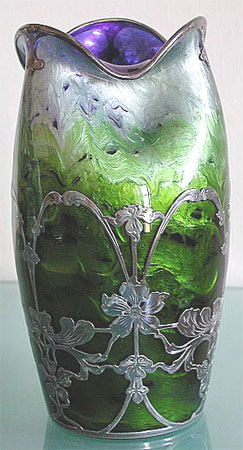
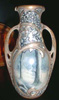
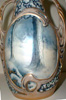
This Loetz
Titania Paperweight vase has great colors of iridescence, royal
dimensions, and great Art Nouveau shape and silver overlay design
standing 9.5" high. Loetz produced this design 1898 - 1905.
Loetz was founded in 1840 by Johann Loetz in Klostermuhle, Bohemia,
which was within the Austro-Hungarian empire during most of
its period of operation. Even though Loetz died in 1848, the
Loetz factory was initially operated by his wife under the name
Glasfabrik Johann Loetz-Witwe (the Widow Johann Loetz Glassworks).
It retained that name until its closing during the Second World
War. By the early 1880s the Loetz works had acquired a reputation
as a manufacturer of fine glass, produced under the direction
of Loetz's grandson Max Ritter von Spaun. Reference
Source: Loetz:
Bohemian Glass 1880-1940 by
Johann Lotz Witwe,
Helmut Ricke, Jan Mergl
|

Loetz:
Bohemian Glass 1880-1940 |
|
photo
3
|
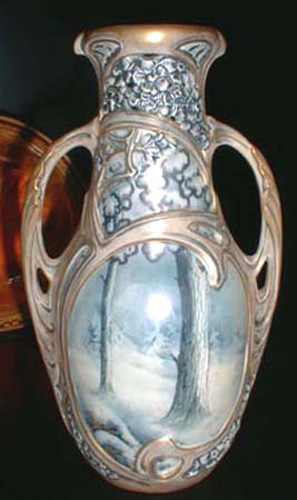
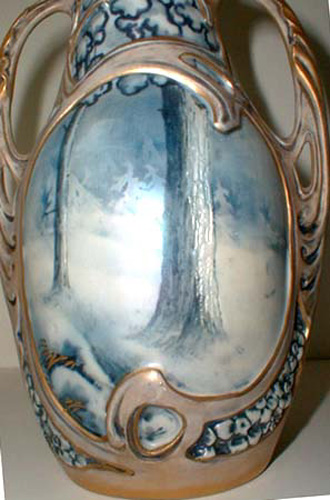
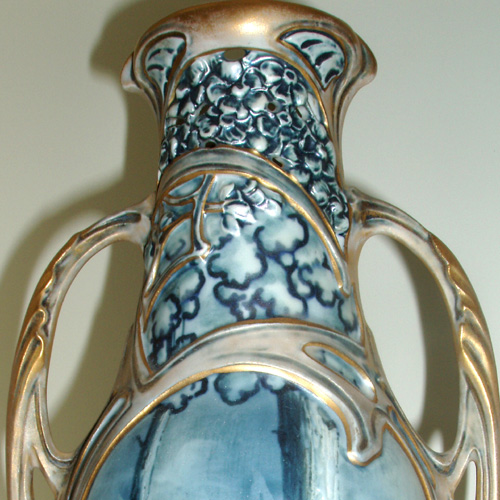
Turn-Teplitz
Amphora
two handled vase c.1910 with hand painted winter scene on both
sides of trees in a snowy forest. The bottom is marked with the
Turn mark and the impressed mark amphora. Painted scenery on period
amphora is less common and differs by the quality of the artist.
The Turn-Teplitz area of Bohemia produced some of the finest amphora,
and work produced in this area is often referred to as simply
"Teplitz." |
|
photo
3
photo
4
photo
5 |
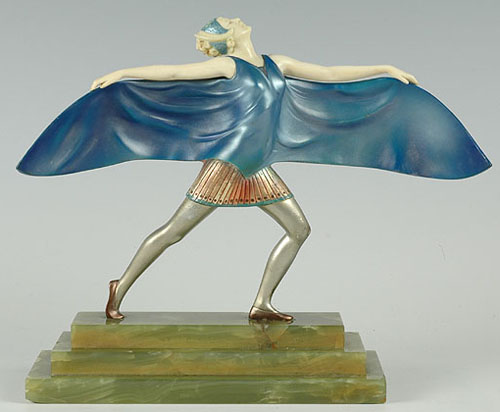
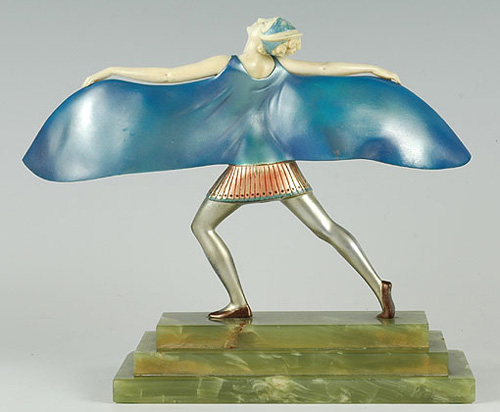
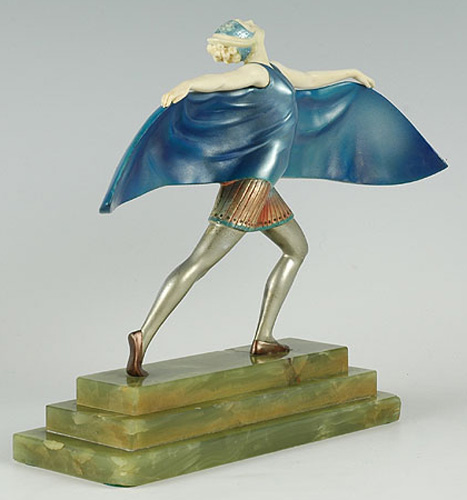
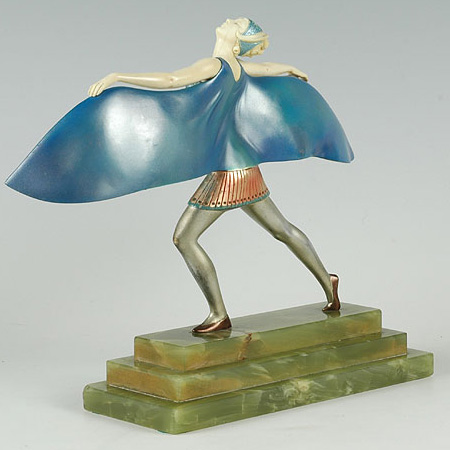
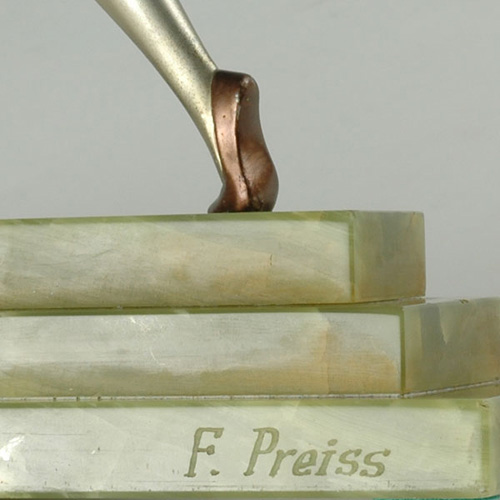
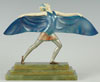
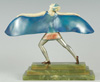
Bat Dancer
by Ferdinand Preiss, a ffabulous cold painted bronze and carved
ivory figure of an Art Deco flapper in full dance costume with
excellent color and detail. The cold painted costume features
outstretched 'bat wings' based on the dancer Niddy Impekoven,
a dramatic look that captures the vitality of the Art Deco period.
Born in Erbach-Odenwald, Germany on February 13, 1882, sculptor
Ferdinand Preiss studied in Paris and worked with equally famous
Art Deco sculptor Professor Otto Poertzel in Berlin. Preiss worked
to a great extent with ivory and used the combination of ivory
and bronze to achieve magnificent results. His family were renowned
ivory carvers and his skill, detailing, and modelling in this
medium was unsurpassed in the Art Deco era. His stunning young
ladies of the early 20th century captured the energy and seduction
of the period, none more so than the Bat Dancer. Reference
Source: Ferdinand
Preiss, Art Deco Sculptor - The Fire And The Flame
by Alberto
Shayo |

Ferdinand
Preiss, Art Deco Sculptor - The Fire And The Flame
|
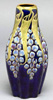 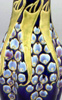 |
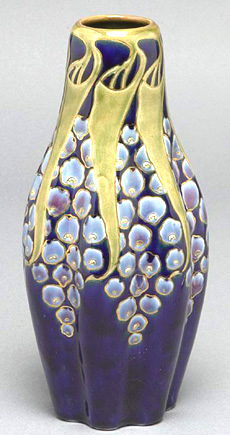
Fine Zsolnay
Pecs Art Nouveau vase with porcelaneous body and the vibrant
colors and glaze for which Zsolnay is known, c. 1900. The swelling
ribbed cylindrical vase decorated with wisteria blossoms
and foliage, on a blue ground. The bottom of the vase is impressed
5570, the circular seal factory mark, and 23. It measures approximately
9.50" high and 4.25" in diameter at the widest point. Reference
Source: Zsolnay
Ceramics: Collecting a Culture by Federico
Santi, John Gacher |

Zsolnay
Ceramics: Collecting a Culture
|
|
|
Cool
Coupons & Promo Coupon Codes for Disney, Brookstone,
Avon, Netflix, eBags, and more @ our Coupon
Site!
|
|
|
|
|
|
Amazon.com:
Earth's Biggest Store!
|
|
|
|
Collector Book Purchases & Advertising Support Our
Free Online Museums, Antiques & Collectibles Information,
and Directories - Thank You! |
|
|
|
|
|
|
|
Display
Cases for collectibles, figurines, diecast
cars, sports memorabilia, dolls, and more!
|
|
Privacy
Policy
|
|
Copyright
© 1998 - 2014 Collectics. All rights reserved.
|
|