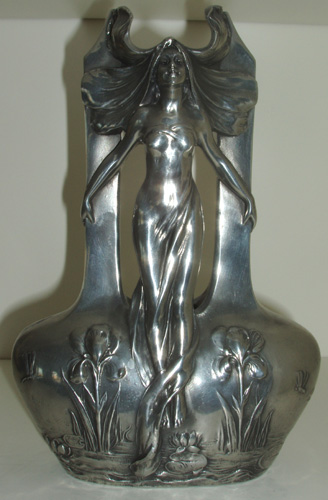
|
Antiques,
Collectibles, Vintage Shopping
|
|
|
|
Collector
Books, Reviews, Education
|
|
|
|
Online
Museums & Directories
|
|
|
|
Discover
Collectics Variety
|
|
|
|
|
|
|
|
|
Vintage
Sunglasses Shop - Authentic
vintage Revo, Ray-Ban, Armani,
Carrera, Alpina, Cazal, Persol, Vuarnet,
Bolle, Oliver Peoples, and French
cat's eye sunglasses!
|
|
|
|
Collectics
Antique & Vintage Sale
Coupon: Save 10% On Entire
Order!
|
|
|
|
Thanks
to the top antique dealers and private collectors
who allow us to feature their collections in
our online museum gallery, featuring the Art
Nouveau, Art Deco, and Arts & Crafts design
periods of the early 20th century. Among others,
we feature the work of Louis Comfort Tiffany,
Handel, Pairpoint, Galle, Loetz, Lalique, Demetre
Chiparus, Bruno Zach, Frankart, Stickley, Roycroft,
Rookwood, Newcomb, Grueby, and Turn Teplitz
Amphora. These pieces are not for sale and are
displayed here along with reference information
to be fun and educational. Continue learning
about finer antiques and collectibles on the
Collectics Antiques
Information & Education program pages,
and find the best collector reference books
and antique price guides in the Antique
Collector Bookstore.
Find
out why Collectibles Guide 2010 calls
Collectics the "best online shopping for antiques
and collectibles with prices 30% less than your
local antique shop or thrift store." Explore
our eclectic selection of antique and vintage
pottery, porcelain, glass, memorabilia, bakelite
& lucite, vintage jewelry and accessories,
and more in our main Antique
& Vintage Shop and Mall.
Can't
decide what to buy or need a great gift? Collectics
Gift
Certificates let your recipient select something
they really want from our extensive selection
of antiques, collectibles, and the best antique,
vintage, and retro jewelry and home furnishings
for sale online- all with free shipping! Thanks
for visiting and shopping at Collectics!
|
| Explore
the Antiques & Collectibles Mall |
|
|
|
Photo
click to enlarge
|
Art
Deco, Art Nouveau, and Arts & Crafts Design Museum 1890-1935:
Gallery 3
|
Museum Pages:
Gallery
1, Gallery
2, Gallery 3, Gallery
4, Gallery
5
Related
Bookstore Pages: Tiffany
Studios, Lamps
& Lighting, Art
Deco/ Nouveau/ Arts & Crafts, American
Pottery, Pottery,
Glass
& Crystal, Porcelain
& China,
Silver
& Metalware
|
|
Collectics Antique & Vintage Coupon
Code: Save 10% On Entire Order!
|
|
Save
& Learn!
|
Schiffer:
The Antique Collector Books & Price Guides Dealers
Use!
|
|
photo
3
photo
4
photo
5 |
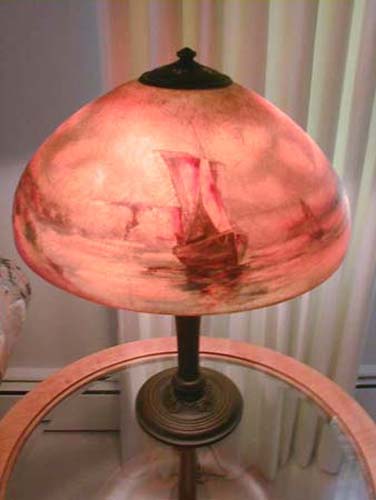
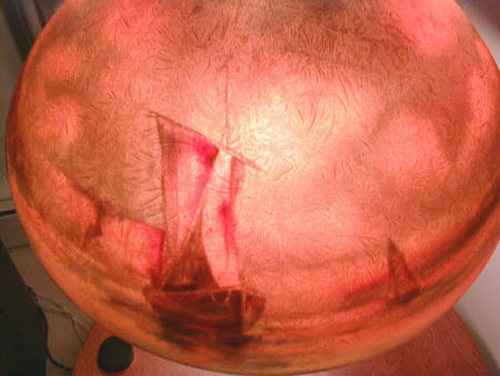
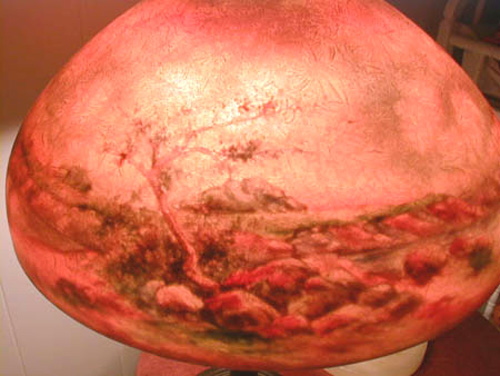
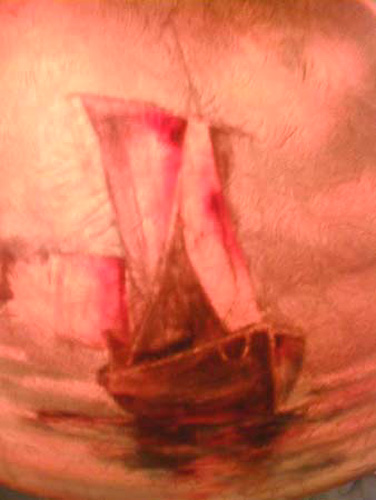
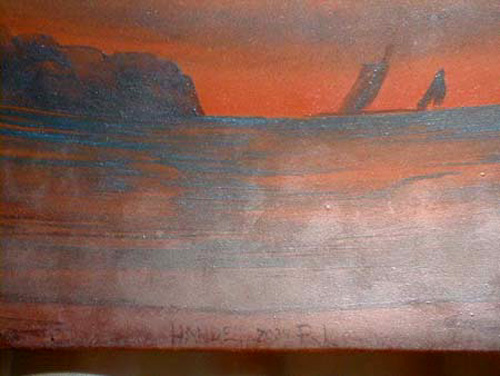
This Handel
lamp is known as the Fisherman, numbered 7034 and artist signed
PAL for artist Mary Palme. This shade is done from the chipped
ice shade blank but is also sand finished to give it a different
highlighted dimension when lighted. Mary Palme executed an image
of the fisherman throwing his net overboard clearer than most
of the Handel shades painted with this design. This period Handel
lamp stands 22" high and the shade is 18" in diameter. The base
is a three light cluster of sockets, all Hubbel with bell pull
chains. The base is solid bronze and intricately styled with draping
leaves on a turned baluster stem. The majority of Handel bases
are pot metal with bronze plating; the solid bronze bases such
as this one were much less common and of higher quality. Philip
J. Handel established the Handel Company in Meriden, Connecticut
in the 1870s and by 1890 they had established a reputation for
specializing in painted lamp shades. Philip Handel died in 1914
at the age of 48, and his second wife, Fanny Hirschfeld, took
over her husband's role as President for a time before turning
the company over to Handel's cousin William in 1919. The years
following WW II were Handel's most prosperous, led by an impressive
group of skilled and dedicated artists and craftsmen. The great
depression hit Handel hard, and they struggled through the early
years of the 1930s before production ceased in 1936. Reference
Source: The
Handel Lamps Book by
Carole Goldman Hibel, John Hibel, John Fontaine
|

The
Handel Lamps Book
 |
|
photo
3
photo
4
photo
5
|
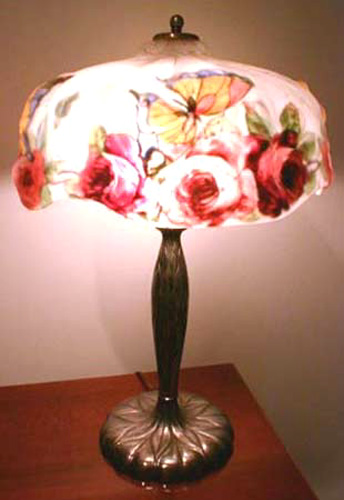
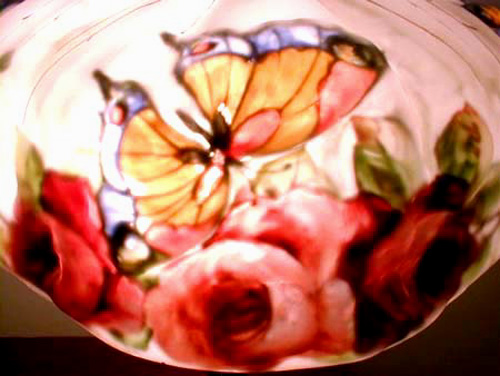
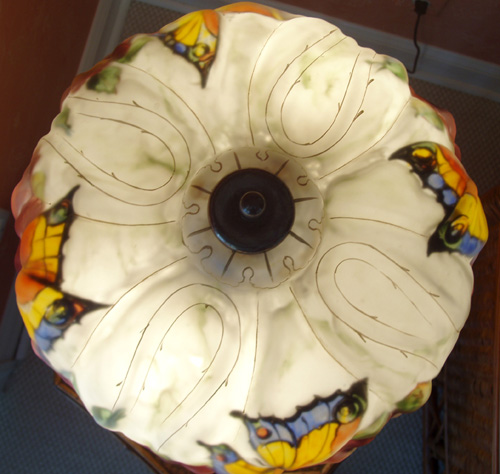
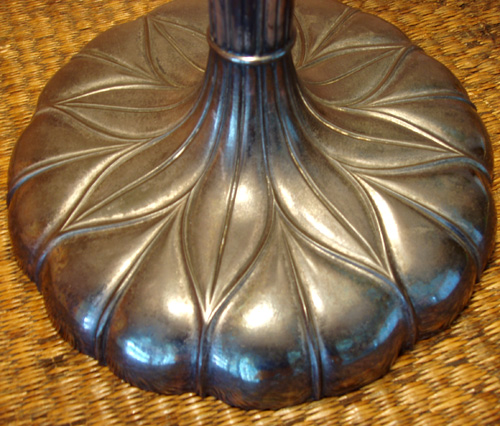
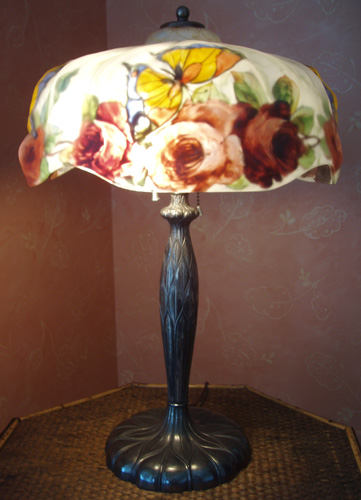
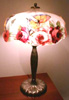
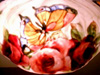
This beautiful
Pairpoint
puffy rose and butterfly lamp shade measures 14" in diameter and
rests on a Pairpoint silverplate base, all properly marked The
Pairpoint Corp. Total height of the lamp measures 21". The shade
is blown out, i.e. "puffy", to give the rose flowers texture and
depth, and the entire shade is reverse painted on the interior
of the glass shade. Pairpoint Manufacturing Company was established
in 1880 in New Bedford, Massachusetts. The factory began as a
metalworks which first made fittings for coffins. Near the Pairpoint
factory was the Mt. Washington Glassworks which made fine glassware,
and the two companies began exploring synergies culminating in
a merger in 1894. From the late 1890s until the 1930s, lamps and
lamp accessories were an important part of Pairpoint's production.
There were three main types of shades, all of which were blown:
puffy - blown-out reverse-painted shades (usually floral designs);
ribbed - also reverse painted; and scenic - reverse painted with
scenes of land or seascapes (usually executed on smooth surfaces,
although ribbed scenics may be found occasionally). Cut glass
lamps and those with metal overlay panels were also made. Scenic
shades were sometimes artist signed. Most shades were stamped
on the lower inside or outside edge with either 1) The Pairpoint
Corp., 2) Patent Pending, 3) Patented July 9, 1907, or 4) Patent
Applied For. Bases were made of bronze, copper, brass, silver,
or wood, and are always signed. Reference
Source: Pairpoint
Lamps by Edward Malakoff, Sheila
Malakoff |

Pairpoint
Lamps
|
|
photo
3
|
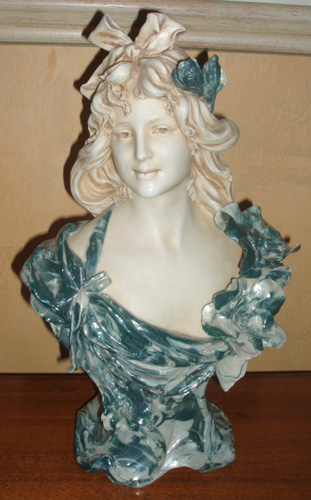
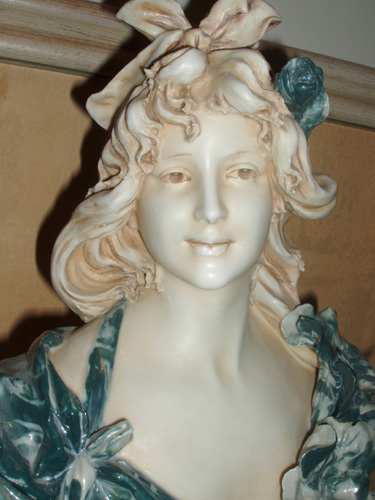
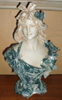
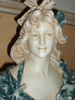
Large female porcelain
bust by Royal Dux c. 1900. This bust has the original small
pink Triangle with the E and Royal Dux Bohemia. The markings
also include the impressed numbers 624 and 18. The bust stands
a full 15" high making it one of the larger pieces produced.
Royal Dux was founded in 1860 in Dux, Bohemia. Dux pieces pre-1918
have an E in the pink triangle; post 1918 work has a D within
the triangle. Bohemia ceased to exist at that time and Czechoslovakia
came into existence. Royal Dux was rivaled by the Teplitz, Austria
amphora factories in the production of high quality female busts
in the Art
Nouveau style.
|

Art
Nouveau, 1890-1914
|
photo
3
photo
4
photo
5 |
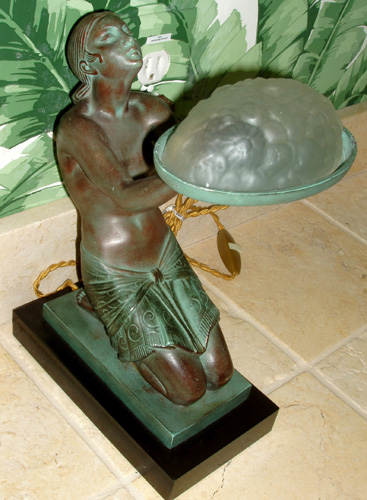
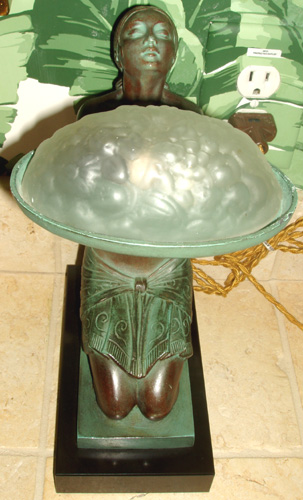
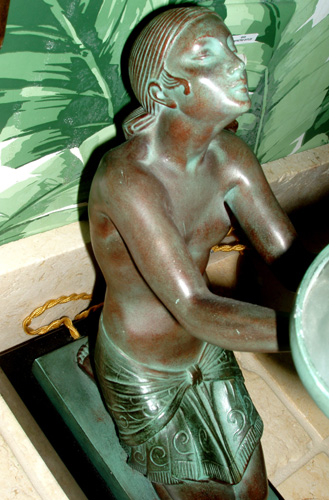
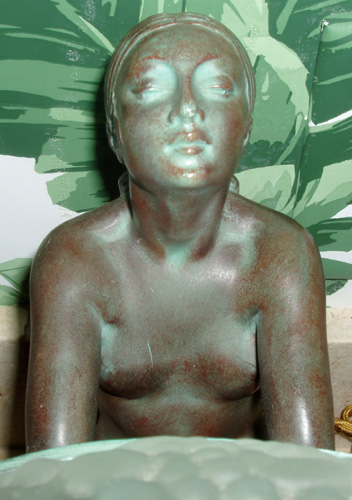
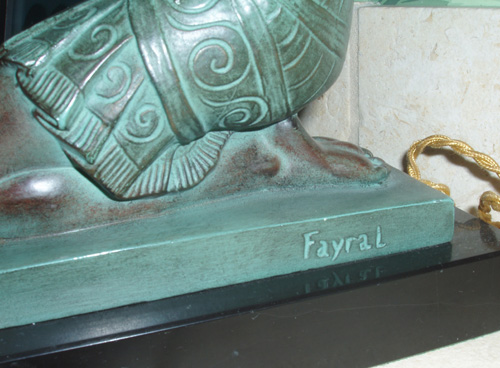
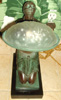
French figural
Art Deco
boudoir lamp c. 1930 of a white metal kneeling female figure with
green patina on a black onyx base. This is a perfume lamp, with
an inset in the glass into which scented oils were placed which
gave off an aroma when heated by the light. The sculpture is signed
by the well known French Art Deco artist Fayral and includes the
original foundry mark indicating Parisian origin. The lamp stands
11" high, 7.825" long, and 4.25" wide. The onyx base itself stands
1.25" high. Boudoir and perfume lamps were quite popular in the
Art Deco period as expressions of the art. Reference
Source: Popular
Art Deco Lighting: Shades of the Past by Herb Millman, John
Dwyer |

Popular
Art Deco Lighting: Shades of the Past
|
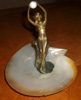 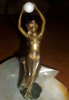 |
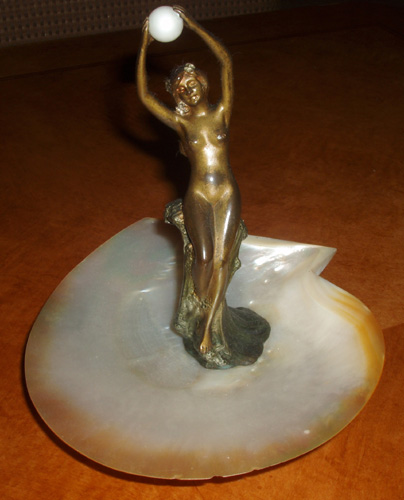
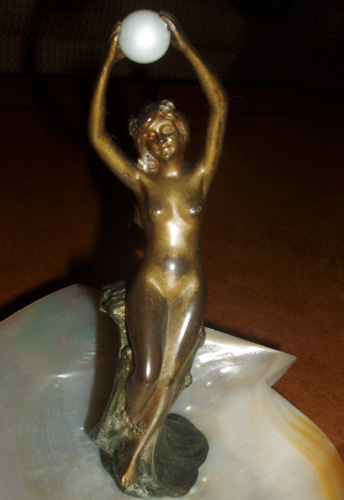
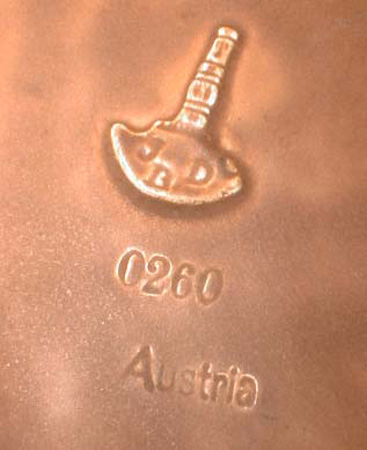
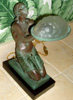
Period Art
Nouveau Austrian bronze of a nude woman mounted on a mother
of pearl shell and holding a pearl, circa 1900. The mother of
pearl is approximately 6.5" in diameter and the bronze nude stands
6.5" high to the top of the pearl, making the entire piece stand
7.5" high. Original patina on the bronze and marked "Austria."
During this period, there were many quality bronze foundries in
Austria doing work for local artists such as Bergman. |
|
photo
3 |
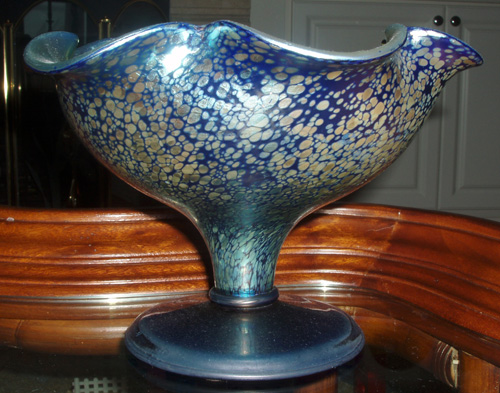
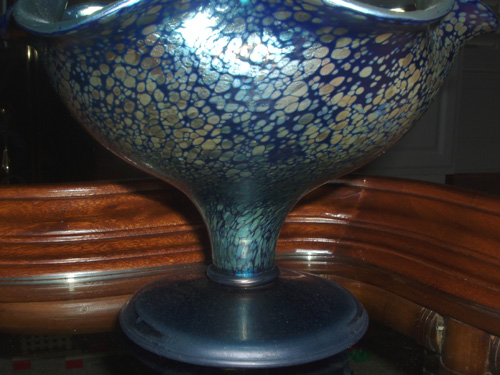
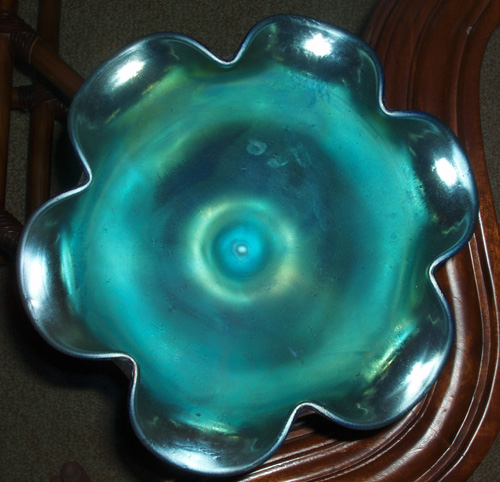
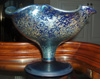
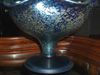
Loetz
Papillon glaze compote of blue iridescent glass features the
famous Loetz oil spot decoration and stands 6" high and 7.25"
wide. The interior of the compote is finished with blue and
silver iridescence, a really striking contrast with the exterior
oil spots. Many Loetz glassmaking techniques rivaled Tiffany
in complexity and beauty. Reference
Source: Loetz:
Bohemian Glass 1880-1940 by
Johann Lotz Witwe,
Helmut Ricke, Jan Mergl
|

Loetz:
Bohemian Glass 1880-1940 |
 
photo
3 |
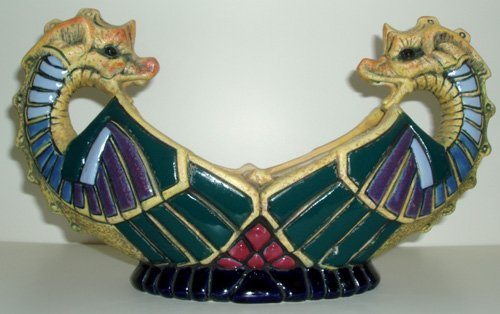
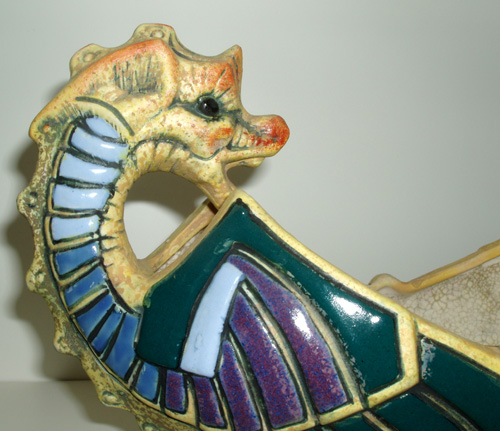
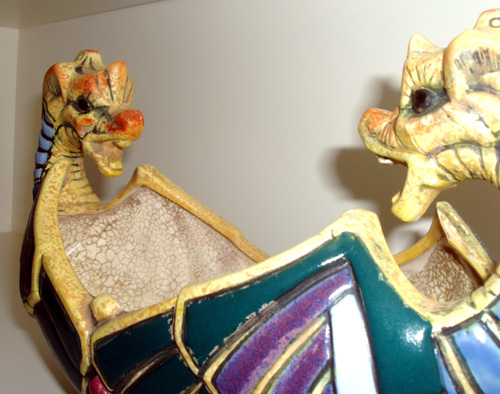
Czechoslovakian
Amphora
double dragon bowl. Twin dragon heads guard each side of this
jeweled amphora bowl. The bottom is marked "Amphora Made in Czechoslovakia,
and the piece measures 12" long by 7" high. Austrian amphora is
usually more highly valued, but an interesting piece like this
and the jeweled effect make this Czech piece highly collectible.
|
|
photo
3
photo
4
photo
5
photo
6
photo
7 |
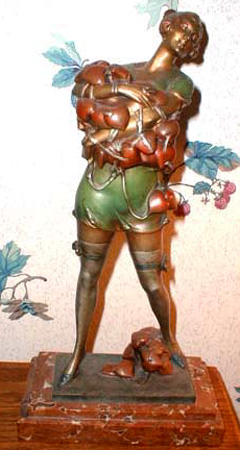
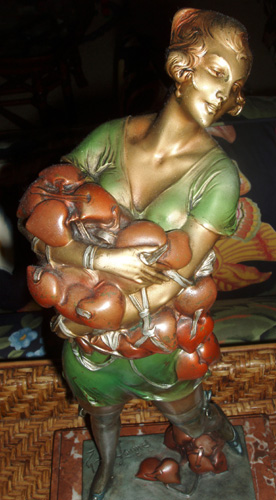
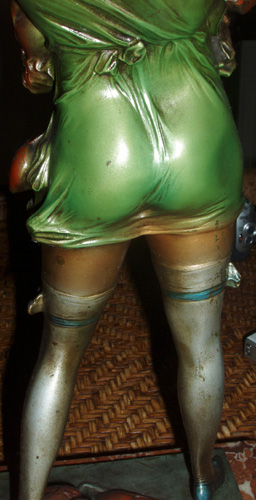
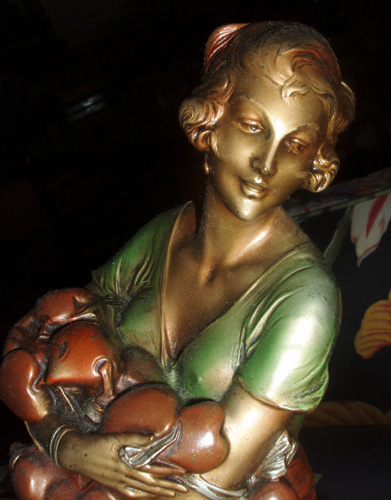
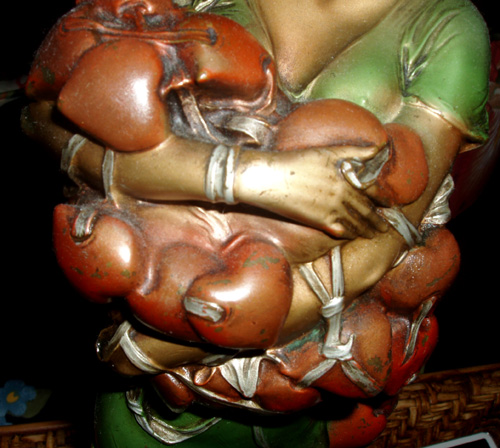
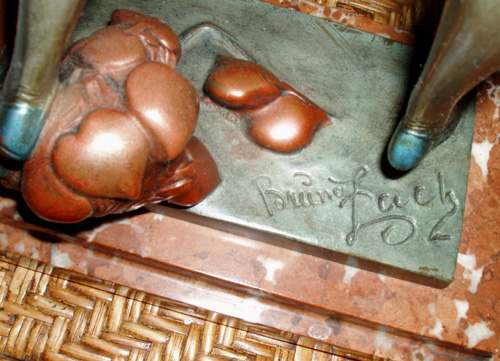
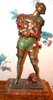
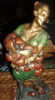
A period Bruno Zach cold
painted bronze on a pink marble base c. 1930. Bruno Zach was
a period Art Deco sculpture who frequently did erotic pieces
and various interpretations of prostitutes. This particular
piece is quite rare, a depiction of his favorite prostitute
whom he tried to marry, and whom he depicts holding a string
of broken hearts representing all the men's hearts she had broken.
Signed in the bronze Bruno Zach. The figure stands 15.25" high
on an old base 7.25" long by 4.25" deep. Reference
Source: Art
Deco and Other Figures by Bryan
Catley
|

Art
Deco & Other Figures
|
  |
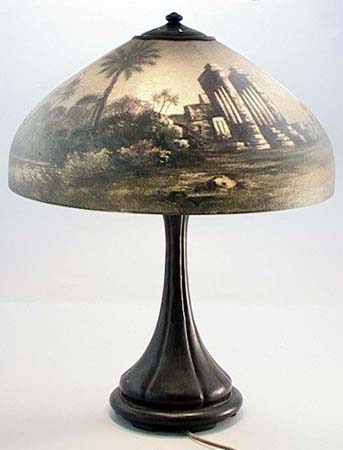
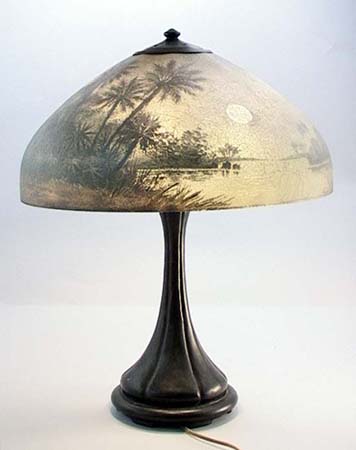
Important Handel
Scenic Ruins reverse painted table lamp c. 1900 in excellent
condition. This outstanding example of a top Handel reverse
painted glass shade depicts Greek or Roman ruins alongside green
foliage and swaying palm trees as well as a moonlit inlet with
shimmering water and palm trees leaning out from shore. The
lamp stands approximately 23.0" high and the shade is 18.0"
wide. Shade is properly signed Handel along with the shade number.
Reference
Source: The
Handel Lamps Book by
Carole Goldman Hibel, John Hibel, John Fontaine
|
The
Handel Lamps Book
|
|
photo
3
|
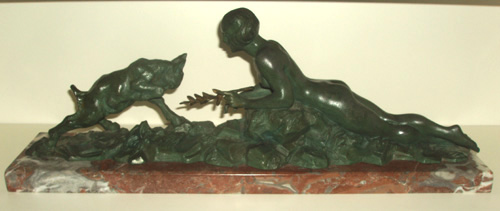
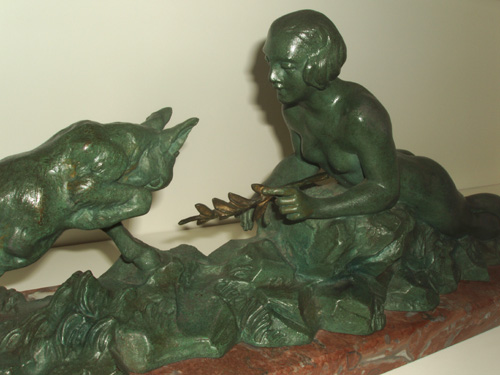
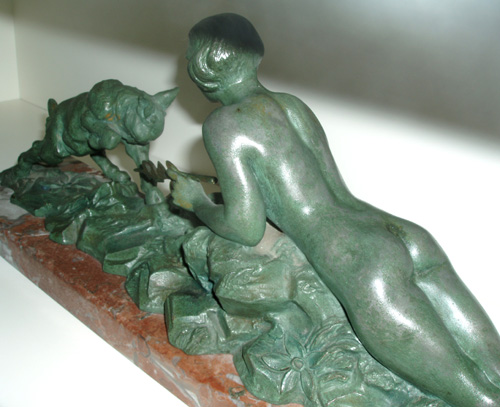
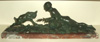
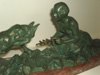
Art Deco
white metal grouping of a woman and a goat with verdigris on a
pink marble base. On the rear is the signature "Limousin." The
work measures 20.5" long by 4.5" wide by 5.5" high. Limousin did
a lot of Art Deco work in spelter for the masses. During the period,
the public wanted the Art Deco look, and of course even then bronze
works were very expensive relatively speaking. Limousin was one
of the premier firms serving this market. |
|
photo
3 |
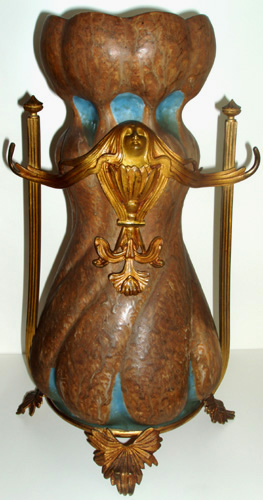
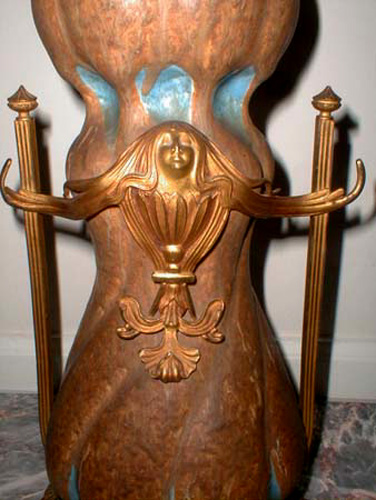
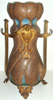
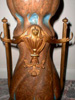
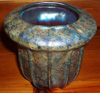
Monumental Julius Dressler
Austrian Art Nouveau vase c. 1900 in Alphonse
Mucha designed bronze mounts standing 15.25" high. The firm
of Julius Dressler was established in Biela about 1883 and closed
in 1944. Julius Dressler was known for some of the finest work
of the period 1890-1905, reminiscent of the work of Zsolnay,
Amphora and the work of Zsolnay in Bohemia. This lovely vase
combines a mottled brown glaze with subtle accents of blue,
meant to complement but not overpower the rare bronze Art Nouveau
mounts. The detail in the gilt bronze is very refined, and the
piece is fully marked on the bottom with the Dressler impressed
and raised marks and of course Austria. Reference
Source: Art
Nouveau, 1890-1914 by Paul Greenhalgh
|
Art
Nouveau, 1890-1914
|
|
photo
3
photo
4
|
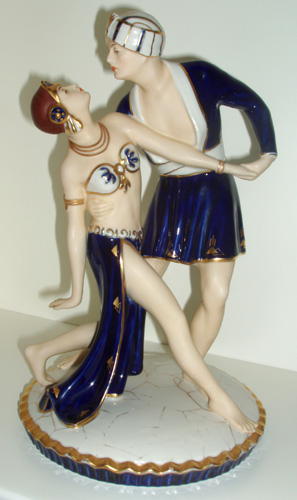
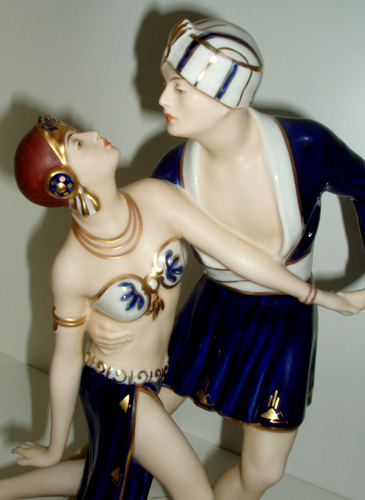
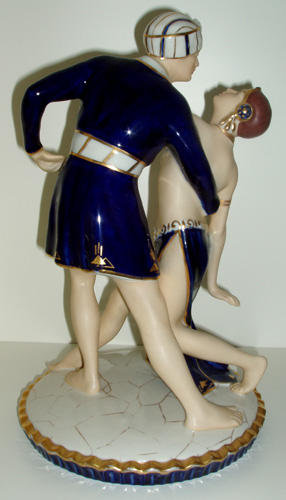
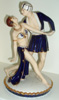
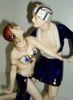
Royal Dux
Bohemia Art Deco dancers c. 1918. This is a transition piece for
Royal Dux, produced right at the end of World War I when the original
pink triangle with the E in the center was being phased out for
the new, larger pink triangle with a D, and Czechoslovakia was
being added to the markings on Dux pieces. This interesting piece
has the small pink E triangle but also has in very small print
Royal Dux Czechoslovakia. This work displays the typical use of
Dux cobalt blue at the beginning of the deco period. The base
is 8.5" in diameter and the piece is 12" high. |
|
 |
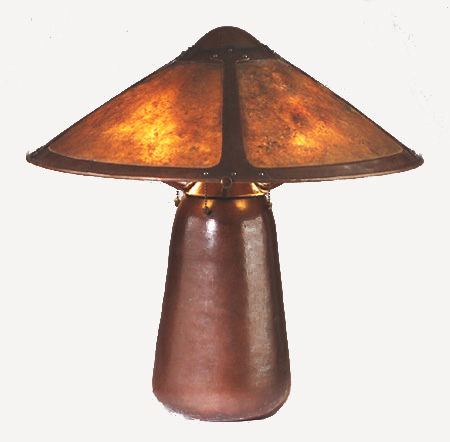
Classic Dirk
van Erp hand hammered copper table lamp with 4 sockets and
a flaring 4 panel original mica shade with cupped rim and bulbous
cap. The shade is supported by 4 riveted armatures on a bullet-shaped
base, all with the original patina. At his peak, van Erp employed
no more than 13 coppersmiths who manufactured his designs, and
some reports cite as few as 5 not including his son and his daughter
Agatha who worked at the company. Unlike Tiffany
Studios lamps which were produced according to blueprints
and forms, Dirk van Erp production was completely handmade and
resulted in subtle variations in size, style, and hammering of
the individual work. This rare D'Arcy Gaw / Dirk van Erp lamp
stands approximately 22.0" high and has a 22.0" in diameter flaring
mica shade, and it's properly marked on the bottom with the closed
box mark and Dirk van Erp. Reference
Source: Stickley
Style: Arts and Crafts Homes in the Craftsman Tradition
by David Cathers |

Stickley
Style: Arts and Crafts Homes in the Craftsman Tradition
|
 |
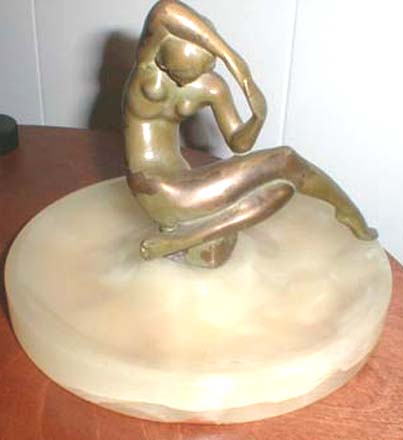
Round onyx
figural ashtray with seated female posing nude on a square plinth,
c. 1930 in the Art Deco style. The bronze figure has gold painting
and gold/bronze patina. The piece is a total of 5" high by 5.5"
wide; the figure itself is 4.5" high. While attribution is difficult
on such unmarked pieces, an experienced dealer can usually determine
origin from other factors, in this case an Austrian style. Reference
Source: Art
Deco: 1910-1939 by Tim
Benton, Charlotte Benton, Ghislaine Wood |

Art
Deco: 1910-1939
|
photo
3
photo
4 |
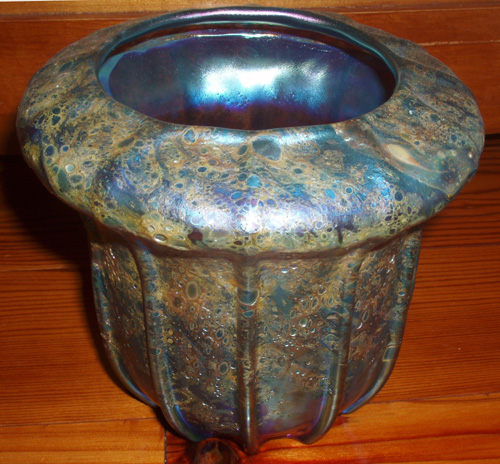
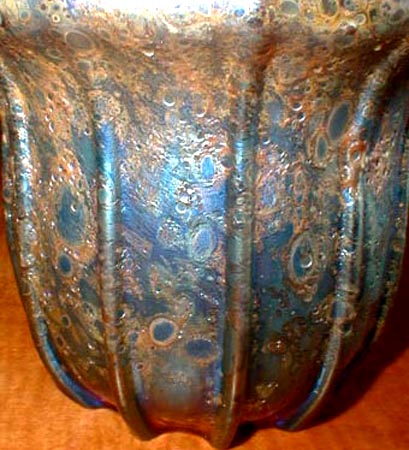
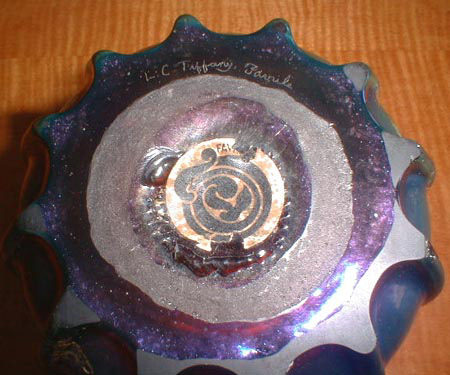
Important
Louis Comfort Tiffany Cypriote Favrile glass vase c 1904, blue
with purple, gold, and cranberry iridescence evident in one of
the rarest of Tiffany glass styles. In addition to the glass texture
characteristic of L.C.T. Cypriote Favrile glass, this vase also
has a unique and complex shape that adds additional flair and
complicated the glassmaking craftsmanship. Louis Comfort Tiffany's
lustering technique, with its iridescent effect, was the most
important because it was his hallmark, used in many different
wares. This involved dissolving salts of metallic oxides in the
molten glass, so creating the chosen colors -- soft greens, blues,
golds, etc. The metallic content was then brought to the surface
by subjecting the glass to a reducing flame and spraying with
another chloride. This treatment caused the surface to crackle
into a profusion of tiny lines that refracted light. Cypriote
glass was a Tiffany specialty glass and was rolled in fragmented
crumbs of glass to give the impression of old Roman glass, done
only in the early years of Tiffany production with very few pieces
made.. The Cypriote vase shown here measures 5.5" high and
5.75" in diameter at the widest point, and note that the
bottom has the etched L. C. Tiffany Favrile as well as the original
paper sticker from the Tiffany Glass & Decorating Company.
Reference
Source: Tiffany
Favrile Art Glass by Moise
S. Steeg |

Tiffany
Favrile Art Glass
|
 |
Rare and unusual
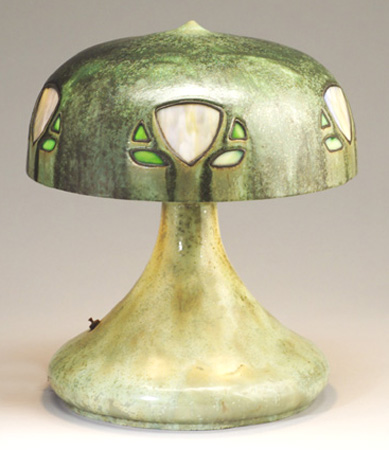
Fulper mushroom lamp in mint condition, with the shade inset with
leaded slag glass covered in a terrific "leopard skin" crystalline
glaze. Fulper was created in the midst of the arts and crafts
movement, but they were concerned that production techniques reflecting
the values of the American arts and crafts movement of hand craftsmanship
would make their production unaffordable for the general population.
As such, Fulper made their pottery in molds versus being hand
thorwn on a wheel by a master potter. Both pieces of the 18.5"
high and 15.25" diameter lamp are properly marked with the Fulper
ink mark c. 1930. Reference
Source: The
Fulper Book by John Hibel |

The
Fulper Book |
|
|
Cool
Coupons & Promo Coupon Codes for Disney, Brookstone,
Avon, Netflix, eBags, and more @ our Coupon
Site!
|
|
|
|
|
|
Amazon.com:
Earth's Biggest Store!
|
|
|
|
Collector Book Purchases & Advertising Support Our
Free Online Museums, Antiques & Collectibles Information,
and Directories - Thank You! |
|
|
|
|
|
|
|
Display
Cases for collectibles, figurines, diecast
cars, sports memorabilia, dolls, and more!
|
|
Privacy
Policy
|
|
Copyright
© 1998 - 2014 Collectics. All rights reserved.
|
|