| Sam Weller
first started making pottery in Fultonham, Ohio about 1872 for mostly local
farmers in the nearby Ohio towns and villages. Quite distinct from the
art pottery wares into which he evolved, Sam Weller started out making
everyday items such as jars, jugs, tiles, and other pottery used in daily
lives. While the styles were still simple, he nevertheless benefited from
the rich local clays in the area as did many other top quality makers of
art pottery over the next 60 years. Weller moved to the Zanesville, Ohio
area about 1889 and, influenced by other potters in the area, he started
making art pottery and a broader diversity of styles-- flower pots, hanging
baskets, umbrella stands, and much more. Growth came quickly to the talented
Mr. Weller, fueling the growth of Weller pottery into a sizeable manufacturing
operation of over 200 employees within the next five years. In 1893, Sam
Weller traveled to the World Columbian Exposition where he was further
exposed to the new work of other art potteries such as Rookwood,
Lonhuda, and others. He was also exposed to new Art Nouveau stylings and
the associated incorporation of nature themes into art pottery. Weller
envisioned making art pottery which could be more mass produced than producers
employing only a handful of talented, high paid artists such as the practice
at Rookwood. Weller saw some of these characteristics in Lonhuda pottery
and bacame acquainted with the founder, William Long. Long and Weller joined
forces in Zanesville and began joint production, but the partnership was
not to last. Weller nevertheless continued making pottery in the style
of Lonhuda, and he renamed his line Louwelsa which was an aggregation of
'lou" (his daughter Louise), "wel" (Weller), and "sa" (Sam's initials).
Louwelsa was an immediate market success.
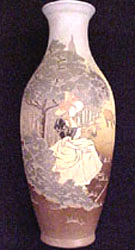
Weller started making portraiture pottery
with Indians, animals, and even whimsical themes from children's stories
such as those of Charles Dickens. Pottery with scenes from Dickens stories
and other people and animal themes became known as Dickensware. Many other
lines followed, and most had some degree of market success. During this
period, Weller also continuously improved his manufacturing techniques,
seeking reasonably high quality detailing in ever less labor intensive
production methods. This allowed Weller to sell a high quality product
at an affordable price. Weller was influenced by the Art Nouveau movement
as well, producing floral themes in the ornate styling of that period,
but he also produced other lines for which the name often belies the style:
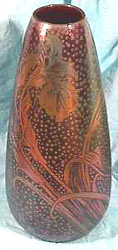
Woodland, Oriental, Hunter, Auroral, etc. One of the best known of the
art pottery lines was known as Sicardo, after the style of the French artist
Sicard which achieved a unique and lustrous glaze seldom seen at the time.
Around the turn of the century, Weller basically reorganized the company
around two divisions. One continued to concentrate on more automated production
techniques to keep quality high but costs low, while the other indulged
ever more into the creation of high end, hand crafted art pottery. Weller
was notable for his contributions to the St. Louis Exposition of 1904 where
many Ohio potteries burst onto a national stage. He actually set up a working
pottery at the fair so visitors could see his workers and production in
action. As a marketing promotion, Weller also creeated what he termed the
world's largest vase, an Aurelian line piece that towered over 7 feet high.
Like many potteries,
Weller was forced to scale back during the years of World War
I as the market for art pottery largely dried up. To survive,
he concentrated on the mass produced wares and was always seeking
cost and labor savings to keep their production affordable to
the general population. While he could not afford hand crafted
artistry and was working almost exclusively from molds, he nevertheless
experimented with new glazes such as "Burnt Wood" (looks just
like the name implies), "Graystone" (looks like granite and
stone) and "Ting" (looks like teak wood). These new glazes were
unique and highly decorative but added little if anything to
the cost of production. In this manner, innovation allowed Weller
to survive where many others failed. Some Weller pieces were
close copies of other lines such as Roseville pine cone, and
pieces are often mistaken today from appearance alone. Sam Weller
died in 1925, leaving the pottery to his nephew Harry who had
been working in the business. Harry died soon thereafter, in
1932, at which point the company was inherited by Sam's two
sons-in-law. Weller survived World War II just as he had the
first world war, but it was a much smaller company that was
able to emerge from the war years. The company continued in
operation until 1948.
Ever been fooled by
a fake or a seller that didn't deliver the goods as described?
At Collectics, we authenticate and stand behind everything we sell, at
prices "30% below your local antique shop" according
to Collectibles Guide 2010. Please browse our main Antiques
& Collectibles Mall to find a treat for yourself or
a great gift for others, all with free shipping. Thanks for visiting and shopping at Collectics!
Buy
period Weller, Roseville, McCoy, Metlox, and other fine art pottery on
the Collectics
Fine Antiques
and Pottery pages, or
search the entire site for great antiques, collectibles, and
crafts for every collector!
Sell
or consign Weller, Rookwood, Fulper, Owens, Van Briggle, and other finer
art pottery at Collectics. Read about our top performing national consignment program for estate and personal collections. |